QAIL Documentation
The AST-Native Query Compiler with Built-in Row-Level Security
QAIL compiles typed query ASTs directly to database wire protocols. No application-level SQL string interpolation on the AST path. Built-in multi-tenant data isolation via PostgreSQL RLS context setup.
Product Map
| Concept | Crate | Purpose |
|---|---|---|
| AST Kernel | qail-core | Typed AST, parser, expressions, RLS context, native access policy |
| Postgres Driver | qail-pg | Async PostgreSQL wire-protocol execution |
| Access Gateway | qail-gateway | AutoREST, WebSocket, OpenAPI, auth/RLS/policy enforcement |
| SchemaOps CLI | qail | Schema pull, live drift diff, phased migrations, lint, codegen |
| Flow Engine | qail-workflow | Declarative workflow state machines |
| Flow Ledger | qail-workflow-postgres | PostgreSQL workflow leases, state, idempotency, side effects, timeouts |
| Vector Bridge | qail-qdrant | Qdrant vector search with AST-compatible filters |
For a deeper orientation, read the Platform Map. It explains which crate owns each safety boundary and which surface to choose for driver, gateway, schema, workflow, or vector workloads.
Latest Updates (August 2026)
- QAIL is now on the
v2.0.0release-candidate line across the Rust workspace crates and CLI. - PostgreSQL SCRAM dependencies now resolve
cmov0.5.4, and gateway metrics/cache dependencies resolvecrossbeam-epoch0.9.20. - Linux
io_uringtransport is now explicit opt-in; Tokio remains the default unless[postgres].io_uring = true,?io_uring=true, driver/pool options, orQAIL_PG_IO_BACKEND=io_uringenables it. - The public API is the AST/DSL path:
Qail::get/add/set/del, typed expressions, relation helpers, RLS contexts, and driver/pool execution. - Compatibility aliases that hid fallible behavior were removed: use
with_rls(&ctx)?andjoin_on(...)?directly. - Legacy raw SQL builder APIs remain out of the normal runtime path; use AST-native commands and session AST helpers instead.
- PostgreSQL cancel-key APIs are bytes-native, matching protocol
3.0and3.2behavior. - Native vertical access policy is now first-class through
qail_core::accessand optional[access]config for operation and column permissions alongside PostgreSQL RLS. - Workflow charge side effects now carry stable idempotency keys, origin metadata, and redacted display payloads for payment/chat surfaces.
- Migration docs use the expand/backfill/contract apply model instead of presenting up/down as the primary workflow.
Read Access Policy for the vertical permission model and Workflows for Flow Engine / Flow Ledger production semantics.
Philosophy: AST = Meaning
If a database doesn’t let us encode semantic intent, we don’t fake it.
QAIL compiles typed query ASTs directly to database wire protocols with typed value encoding.
SQL String vs SQL Bytes
- SQL string: text query assembled in application code.
- SQL bytes: PostgreSQL protocol message bytes (
Parse/Bind/Executeand results) plus encoded bind values. - QAIL guarantee: AST flow removes app-side SQL interpolation as an injection surface.
- PostgreSQL behavior: server parse/plan/execute still applies normally.
Legacy Syntax Notice
Some search engines still surface old QAIL pages showing symbolic forms such as get::users•@id@email@role[active=true][lim=10] or macro snippets such as qail!("get::users:'id'email [ 'active == true ]").
Those pages are from historical pre-1.0 releases and are not the current API guidance.
Current QAIL 2.0.0 application code should use the native AST/DSL path:
#![allow(unused)]
fn main() {
let query = Qail::get("users")
    .columns(["id", "email", "role"])
    .eq("active", true)
    .limit(10);

let rows = driver.fetch_all(&query).await?;
}
Supported Databases
| Tier | Category | Supported | Driver |
|---|---|---|---|
| 1 | SQL-AST | PostgreSQL | qail-pg — Native wire protocol, AST-to-bytes |
| 2 | Vector-AST | Qdrant | qail-qdrant — gRPC + REST, vector search |
Redis support (
qail-redis) was removed inv0.20.0.
❌ Not Supported
- Database protocols outside PostgreSQL and Qdrant are not part of the supported surface.
Quick Example
#![allow(unused)]
fn main() {
use qail_core::{Qail, Operator, SortOrder};

// Build a query with the AST builder
let cmd = Qail::get("users")
    .columns(["id", "email", "name"])
    .filter("active", Operator::Eq, true)
    .order_by("created_at", SortOrder::Desc)
    .limit(10);

// Execute with qail-pg driver
let mut driver = PgDriver::connect("localhost", 5432, "user", "db").await?;
let rows = driver.fetch_all(&cmd).await?;
}
Current Status (Production Ready, Actively Hardened)
| Feature | Status |
|---|---|
| SSL/TLS | ✅ |
| SCRAM-SHA-256 Auth | ✅ |
| Connection Pooling | ✅ |
| AST-Native Migrations | ✅ |
| JSON/JSONB Types | ✅ |
| UUID, Timestamps, INTERVAL | ✅ |
| CTEs (WITH) | ✅ |
| DISTINCT ON | ✅ |
| CASE WHEN | ✅ |
| Ergonomic Builders | ✅ |
| qail-lsp (IDE) | ✅ |
| COPY Protocol | ✅ |
| Arrays (Value::Array) | ✅ |
| Transactions (BEGIN/COMMIT/ROLLBACK) | ✅ |
| Query Plan Caching | ✅ |
| Window Functions (OVER) | ✅ |
| Subqueries & EXISTS | ✅ |
| UPSERT (ON CONFLICT) | ✅ |
| RETURNING Clause | ✅ |
| LATERAL JOIN | ✅ |
| Unix Socket & mTLS | ✅ |
| Savepoints | ✅ |
| UNION/INTERSECT/EXCEPT | ✅ |
| TRUNCATE | ✅ |
| Batch Transactions | ✅ |
| Statement Timeout | ✅ |
| EXPLAIN / EXPLAIN ANALYZE | ✅ |
| LOCK TABLE | ✅ |
| Connection Timeout | ✅ |
| Materialized Views | ✅ |
| Row-Level Security (RLS) | ✅ |
| Multi-Tenant Isolation | ✅ |
TypedQail<T> Relations | ✅ |
| Protected Columns | ✅ |
| LISTEN/NOTIFY/UNLISTEN | ✅ |
Note: QAIL’s AST-native design eliminates app-side SQL interpolation on the AST path. Query plan caching (
prepare(),pipeline_prepared_fast()) is a PostgreSQL performance optimization, not the primary security boundary.
Why Some SQL Features Don’t Exist in QAIL
QAIL is AST-first, not SQL-string-first. Many traditional SQL “security features” exist to mitigate string-construction risks that AST pipelines avoid by design:
| SQL Feature | Why It Exists | QAIL Replacement |
|---|---|---|
| Parameterized Queries | Prevent string injection | Built in — Value::Param is a typed AST node, not a string hole |
| Prepared Statements (for security) | Separate SQL from data | Not primary defense — AST already separates structure from data |
| Query Escaping | Sanitize user input | Not primary path — values are typed (Value::Text, Value::Int) |
| SQL Validators | Detect malformed queries | AST validation + build-time checks handle this path |
The AST Guarantee
#![allow(unused)]
fn main() {
// SQL String (vulnerable):
let sql = format!("SELECT * FROM users WHERE id = {}", user_input);

// QAIL AST (structure is not interpolated from user text):
Qail::get("users").filter("id", Operator::Eq, user_input)
// user_input becomes Value::Int(123) or Value::Text("...")
// — never interpolated into a string
}
Getting Help
Contributing & Support
We welcome issue reports on GitHub! Please provide detailed descriptions to help us reproduce and fix the problem. We aim to address critical issues within 1-5 business days.
Note
Stable Release: QAIL is now on the
1.xstable line. Breaking changes should be treated as release-line decisions and documented inCHANGELOG.md.
Platform Map
QAIL is a small platform made of separate crates. The important split is not the crate names; it is which layer owns which safety boundary.
Layers
| Layer | Crate | Owns |
|---|---|---|
| AST Kernel | qail-core | Query structure, values, expressions, RLS context, schema AST, migration planning, access-policy checks |
| Postgres Driver | qail-pg | PostgreSQL protocol execution, typed value encoding, RLS session setup, pooling, prepared statement cache |
| Access Gateway | qail-gateway | HTTP/WebSocket surface, JWT/dev auth, REST/RPC mapping, tenant guard, allow-listing, gateway policy checks |
| SchemaOps CLI | qail | schema.qail workflows, pull, check, live diff, phased migration apply, typed codegen |
| Flow Engine | qail-workflow | Workflow state machine, waits, resumes, timeouts, branch cursors, side-effect checkpoint hooks |
| Flow Ledger | qail-workflow-postgres | Postgres-backed workflow state, leases, idempotency ledger, side-effect replay, timeout due-row discovery |
| Vector Bridge | qail-qdrant | Qdrant vector search and tenant-aware metadata filters |
Choose The Smallest Surface
Use qail-core + qail-pg when your app already owns routing, auth, and
business logic. This is the normal Rust driver mode:
#![allow(unused)]
fn main() {
use qail_core::prelude::*;
use qail_pg::PgDriver;

qail_core::rls::init_scope_registries_from_tables(&[("orders", "tenant_id")], &[])?;
let ctx = RlsContext::tenant(tenant_id).with_user(user_id);
let cmd = Qail::get("orders")
    .columns(["id", "status", "total"])
    .eq("status", "paid")
    .with_rls(&ctx)?;

let rows = driver.fetch_all(&cmd).await?;
}
Use qail-gateway when the database schema should become a controlled API
surface. The gateway adds HTTP/WebSocket routing, JWT authentication,
operation/column access policy, request limits, EXPLAIN guardrails, and
tenant-boundary checks around the same AST path.
Use qail when changing schema. The CLI is the state/schema tool: it can pull a
live PostgreSQL schema, validate schema.qail, compare drift, and apply
explicit expand/backfill/contract migrations.
Use qail-workflow when business flows need durable pause/resume semantics.
Use qail-workflow-postgres when those flows need production storage for
leases, idempotency, side-effect replay, and timeout due-row discovery.
Use qail-qdrant only for vector workloads. It is not a relational database
adapter; it shares the tenant-aware AST model where that maps cleanly to
Qdrant filters.
Safety Ownership
QAIL does not claim that one crate magically owns every safety property. The boundaries are explicit:
| Safety property | Owner |
|---|---|
| No application SQL interpolation on the AST path | qail-core builders + qail-pg execution |
| Row isolation | PostgreSQL RLS policies, with QAIL setting transaction-local context |
| Operation and column permissions | qail_core::access, optionally loaded by qail-gateway |
| HTTP auth and request shaping | qail-gateway |
| Schema drift detection | qail CLI and qail-core migration planner |
| Durable workflow replay protection | qail-workflow hooks + executor implementation |
| Postgres-backed workflow leases/idempotency | qail-workflow-postgres |
| External provider exactly-once behavior | The application/provider via idempotency keys |
Supported Backends
PostgreSQL is the primary SQL backend. The AST, migration model, RLS context, gateway, and workflow ledger are designed around PostgreSQL semantics.
Qdrant is supported for vector search through qail-qdrant.
Other database protocols are not part of the supported runtime surface. QAIL does not fake support for engines whose semantics do not map cleanly to its AST model.
Naming
The crate names are intentionally literal. The docs use product names to make the architecture easier to discuss:
- AST Kernel:
qail-core - Postgres Driver:
qail-pg - Access Gateway:
qail-gateway - SchemaOps CLI:
qail - Flow Engine:
qail-workflow - Flow Ledger:
qail-workflow-postgres - Vector Bridge:
qail-qdrant
When debugging production behavior, start from the product name and then inspect the owning crate.
Installation
Rust (Recommended)
Add QAIL to your Cargo.toml:
[dependencies]
qail-core = "2.0.0"    # AST and builder
qail-pg = "2.0.0"      # PostgreSQL driver
CLI
Install the QAIL command-line tool:
cargo install qail
TypeScript SDK
npm install @qail/client
Swift SDK
Use the source package in this repository:
sdk/swift/Package.swift
Kotlin SDK
Use the Gradle module in this repository:
sdk/kotlin/build.gradle.kts
Deferred Bindings
- Node.js native binding: deferred
- WASM packaging: deferred
Verify Installation
qail --version
# qail 2.0.0
Quick Start
Connect to PostgreSQL
use qail_pg::PgDriver;

#[tokio::main]
async fn main() -> Result<(), Box<dyn std::error::Error>> {
    // Connect with password (SCRAM-SHA-256)
    let mut driver = PgDriver::connect_with_password(
        "localhost", 5432, "user", "database", "password"
    ).await?;

    // Or with SSL/TLS
    let mut driver = PgDriver::connect(
        "localhost", 5432, "user", "database"
    ).await?;

    Ok(())
}
Execute Your First Query
#![allow(unused)]
fn main() {
use qail_core::Qail;
use qail_core::ast::Operator;

// Build a SELECT query
let cmd = Qail::get("users")
    .columns(["id", "email"])
    .filter("active", Operator::Eq, true)
    .limit(10);

// Execute
let rows = driver.fetch_all(&cmd).await?;

for row in rows {
    let id: i32 = row.get("id")?;
    let email: String = row.get("email")?;
    println!("{}: {}", id, email);
}
}
Use Connection Pooling
#![allow(unused)]
fn main() {
use qail_pg::driver::{PgPool, PoolConfig};
use qail_core::Qail;

let config = PoolConfig::new("localhost", 5432, "user", "db")
    .password("secret")
    .max_connections(20);

let pool = PgPool::connect(config).await?;

// Acquire connection from pool
let mut conn = pool.acquire().await?;
let probe = Qail::get("users").columns(["id"]).limit(1);
let _rows = conn.fetch_all(&probe).await?;
// Connection automatically returned when dropped
}
Run Migrations
# Pull current schema from database
qail pull postgres://user:pass@localhost/db > schema.qail

# Create a new version with changes
# (edit schema.qail manually)

# Diff and apply through the safe phased model
qail diff old.qail new.qail
qail migrate apply --phase expand
qail migrate apply --phase backfill --backfill-chunk-size 10000
qail migrate apply --phase contract --codebase ./src
Schema Layout Examples (Single vs Modular)
Use the built-in samples in this repository:
- Single file:
examples/schema/single/schema.qail - Modular directory:
examples/schema/modular/schema/
Try them:
qail check examples/schema/single/schema.qail
qail check examples/schema/modular/schema
qail check examples/schema/modular/schema.qail
The modular sample includes schema/_order.qail with strict manifest mode:
-- qail: strict-manifest- every discovered module must be listed (directly or through listed directories)
Qail Gateway
Qail Gateway is an auto-REST API server that turns your PostgreSQL database into a full-featured API — with zero backend code. Point it at a database, get instant CRUD, real-time subscriptions, and enterprise security.
Full-featured data API — without GraphQL complexity. Binary AST protocol instead of string-based queries.
Quick Start
# Set your database URL and run
DATABASE_URL=postgres://user:pass@localhost:5432/mydb cargo run --release
The gateway auto-discovers all tables and exposes them as REST endpoints:
GET    /api/{table}              # List (with filters, sort, pagination)
GET    /api/{table}/:id          # Get by ID
POST   /api/{table}              # Create
PATCH  /api/{table}/:id          # Update
DELETE /api/{table}/:id          # Delete
GET    /api/{table}/_explain     # EXPLAIN ANALYZE
GET    /api/{table}/aggregate    # Aggregations
GET    /api/{table}/:id/{child}  # Nested resources (FK-based)
POST   /api/rpc/{function}       # Function RPC with JSON args
Query API
Filtering
All filter operators are supported as query parameters:
GET /api/orders?status=paid                              # Exact match
GET /api/orders?total=gt.100                             # Greater than
GET /api/orders?total=gte.50&total=lte.200               # Range
GET /api/orders?status=in.(paid,shipped)                 # IN list
GET /api/orders?name=like.*ferry*                        # Pattern match
GET /api/orders?name=ilike.*FERRY*                       # Case-insensitive
GET /api/orders?notes=is_null                            # NULL check
GET /api/orders?status=ne.cancelled                      # Not equal
GET /api/orders?tags=contains.premium                    # Array contains
Full-Text Search
GET /api/products?search=ferry+bali                      # Search all text columns
GET /api/products?search=ferry&search_columns=name,desc  # Search specific columns
Uses PostgreSQL’s to_tsvector / websearch_to_tsquery — supports natural language queries.
Sorting
GET /api/orders?sort=created_at                          # Ascending (default)
GET /api/orders?sort=-total                              # Descending (prefix -)
GET /api/orders?sort=-status,created_at                  # Multi-column
Pagination
GET /api/orders?limit=25&offset=50                       # Offset-based
GET /api/orders?limit=25&cursor=eyJpZCI6...              # Cursor-based
Distinct
GET /api/orders?distinct=status # Distinct values
Relationships & Expansion
FK-Based JOIN Expansion
Automatically resolves foreign key relationships with ?expand=:
GET /api/orders?expand=users                              # Inline user object
GET /api/orders?expand=users,operators                    # Multiple relations
GET /api/orders?expand=nested:users                       # Nested FK expansion
Response includes the full related object inline — no N+1 queries. The gateway performs a server-side JOIN.
expand= is for forward (many-to-one / one-to-one) relations. For reverse one-to-many expansion, use nested: to avoid parent-row duplication.
Nested Resource Routes
Access child resources through parent:
GET /api/operators/:id/orders                             # All orders for operator
GET /api/users/:id/bookings?status=confirmed              # Filtered child resources
Mutations
Create
# Single insert
curl -X POST /api/orders -d '{"user_id": "...", "total": 100}'

# Batch insert
curl -X POST /api/orders -d '[{"total": 100}, {"total": 200}]'
Update
curl -X PATCH /api/orders/:id -d '{"status": "shipped"}'
Upsert
curl -X POST /api/orders -H "X-Upsert: true" \
  -H "X-On-Conflict: order_number" \
  -d '{"order_number": "ORD-001", "total": 150}'
Delete
curl -X DELETE /api/orders/:id
Returning Clause
All mutations support ?returning=id,status to get back specific columns after the operation.
Aggregations
GET /api/orders/aggregate?fn=count                        # COUNT(*)
GET /api/orders/aggregate?fn=sum&column=total             # SUM(total)
GET /api/orders/aggregate?fn=avg&column=total             # AVG
GET /api/orders/aggregate?fn=min&column=created_at        # MIN
GET /api/orders/aggregate?fn=max&column=total             # MAX
GET /api/orders/aggregate?fn=count&status=paid            # Filtered aggregation
Function RPC
POST /api/rpc/search_orders
Body: { "tenant_id": "acme", "limit": 25 }               # Named args

POST /api/rpc/rebuild_index
Body: ["orders", true]                                     # Positional args
Authentication & Security
JWT Authentication
The gateway validates Authorization: Bearer <jwt> tokens and extracts tenant context for RLS.
Set JWT_SECRET in the environment:
export JWT_SECRET="your-hs256-secret"
Header-Based Dev Auth
For development, pass claims directly as headers:
curl \
  -H "x-user-id: user-123" \
  -H "x-user-role: operator" \
  -H "x-tenant-id: tenant-abc" \
  /api/orders
Row-Level Security (RLS)
Every query is scoped to the authenticated tenant via PostgreSQL’s native RLS.
The gateway sets transaction-local session variables
(app.current_tenant_id, app.current_user_id, app.is_super_admin)
before each query.
Native Access Policy
Fine-grained access control per table, operation, role, scope, and column:
[access]
enabled = true
path = "access-policy.toml"
# access-policy.toml
default_decision = "deny"

[tables.orders]
operations = ["read", "update"]
read_columns = { only = ["id", "status", "total", "created_at"] }
write_columns = { only = ["status"] }
require_any_role = ["operator", "administrator"]
require_scopes = ["orders:read"]
The gateway still supports the older YAML route policy engine for compatibility, but new deployments should prefer native access policy because it checks the QAIL AST directly.
tenant_idis the primary runtime scope. Since 2.0 anagent_idclaim is an ordinary claim with no effect on the RLS context.
Query Allow-Listing
Lock down which queries can run in production:
# qail.toml
[gateway]
allow_list_path = "allow_list.txt"
Real-Time
WebSocket Subscriptions
Subscribe to table changes via WebSocket (PostgreSQL LISTEN/NOTIFY):
const ws = new WebSocket('ws://localhost:8080/ws');
ws.send(JSON.stringify({
  type: 'subscribe',
  channel: 'order_updates'
}));

ws.onmessage = (event) => {
  const msg = JSON.parse(event.data);
  // type: "subscribed" | "notification" | "error"
  console.log(msg);
};
channel is a client-visible fragment. The gateway derives a tenant-scoped
(t_...) or user-scoped (u_...) PostgreSQL channel. Produce on the matching
channel with Qail::notify_scoped, and use channel_policies in
policies.yaml when fragments require authorization. The reserved
qail_table_ and qail_lq_ namespaces are only for live-query wake-ups and
cannot be manually subscribed.
Live Queries
Auto-refresh query results when underlying data changes:
ws.send(JSON.stringify({
  type: 'live_query',
  qail: "get orders where status = 'paid' order by created_at desc limit 10",
  table: 'orders',
  interval_ms: 2000
}));
Event Triggers
Fire webhooks on database mutations:
- name: order_created
  table: orders
  operations: [create]
  webhook_url: "https://api.example.com/hooks/order-created"
  retry_count: 3
  headers:
    X-Secret: webhook-secret-key
- name: order_updated
  table: orders
  operations: [update]
  webhook_url: "https://api.example.com/hooks/order-updated"
Performance
Response Streaming
For large datasets, stream results as NDJSON:
GET /api/large_table?stream=true
Each row is sent as a newline-delimited JSON object — no buffering the entire result set.
EXPLAIN Endpoint
Inspect query plans without touching production:
GET /api/orders/_explain?status=paid&expand=users
Returns the PostgreSQL EXPLAIN ANALYZE output for the generated query.
Prepared Statement Caching
The gateway caches prepared statements per query shape, eliminating repeated parse overhead.
Query Cache
LRU cache with TTL and table-level invalidation. Identical queries hit cache instead of the database.
Observability
Prometheus Metrics
GET /metrics
Exposes request counts, latencies, error rates, and connection pool stats.
Request Tracing
Every response includes:
x-request-id— unique request identifierx-response-time— duration in milliseconds
Health Check
GET /health
Schema Introspection
GET /api/_schema         # Full schema with tables, columns, types, FKs
GET /api/_openapi        # Auto-generated OpenAPI 3.0 spec
Benchmark: Gateway vs GraphQL (Current)
The gateway’s ?expand= executes server-side JOINs over HTTP (single-query shape).
| Network Profile | Qail AST (uncached) | Gateway (?expand=) | GraphQL + DataLoader | GraphQL naive (N+1) |
|---|---|---|---|---|
Loopback (RTT=0us) | 146.9us (1 query) | 164.5us (1 query) | 146.8us (2 queries) | 4.74ms (101 queries) |
Simulated RTT (RTT=1000us/query) | 1237.8us (1 query) | 1248.4us (1 query) | 2287.0us (2 queries) | 111.56ms (101 queries) |
On loopback, DataLoader and single-query paths are very close. As RTT increases, one-query gateway/AST paths pull ahead because they pay fewer round trips.
?expand=resolves expansions through JOINs in one SQL execution shape, avoiding resolver-level fan-out.
Architecture & Invariants
This page describes the gateway’s internal architecture — the request lifecycle, security boundaries, and the invariants that make multi-tenant isolation structural rather than behavioral.
Read time: ~10 minutes.
Recent hardening:
- Policy evaluation now avoids premature deny outcomes when later matching policies allow the operation.
- Handler execution paths consistently run command optimization before DB execution.
- Native access policy now covers operation and column checks across gateway execution paths.
Request Lifecycle
Every HTTP request flows through a fixed, ordered pipeline:
 Client Request
       │
 ┌─────▼─────────────────────────────────────────────────────┐
 │  1. CORS + Security Headers                               │
 │     X-Content-Type-Options: nosniff                       │
 │     X-Frame-Options: DENY                                 │
 │     Body size limit: 2 MiB                                │
 ├───────────────────────────────────────────────────────────┤
 │  2. Rate Limiter                                          │
 │     Token bucket per IP (configurable burst + rate)       │
 │     → 429 Too Many Requests on exhaustion                 │
 ├───────────────────────────────────────────────────────────┤
 │  3. Authentication                                        │
 │     JWT validation (HS256) -> extract tenant_id,           │
 │     user_id, role/scope claims                            │
 │     Dev headers only when QAIL_DEV_MODE=true              │
 ├───────────────────────────────────────────────────────────┤
 │  4. Policy Checks                                         │
 │     Native TOML/JSON access policy for operation/columns  │
 │     Legacy gateway policy compatibility when configured   │
 │     → 403 Forbidden on policy violation                   │
 ├───────────────────────────────────────────────────────────┤
 │  5. Tenant Concurrency Gate                               │
 │     Per-tenant semaphore (configurable permits)           │
 │     Prevents one tenant from consuming all connections    │
 │     → 429 on tenant saturation                            │
 ├───────────────────────────────────────────────────────────┤
 │  6. Connection Acquisition                                │
 │     pool.acquire_with_rls(RlsContext) or                  │
 │     pool.acquire_with_rls_timeout(RlsContext, timeout)    │
 │     Sets PostgreSQL GUCs:                                 │
 │       set_config('app.current_tenant_id', '...', true)    │
 │       set_config('app.current_user_id', '...', true)      │
 │       set_config('app.is_super_admin', '...', true)       │
 ├───────────────────────────────────────────────────────────┤
 │  7. EXPLAIN Pre-Check (reads only)                        │
 │     EXPLAIN on generated SQL before execution             │
 │     Rejects if cost > explain_max_cost                    │
 │              or rows > explain_max_rows                   │
 │     → QUERY_TOO_EXPENSIVE with structured JSON detail     │
 ├───────────────────────────────────────────────────────────┤
 │  8. Query Execution                                       │
 │     AST → SQL transpilation → prepared statement cache    │
 │     PostgreSQL RLS policies filter rows invisibly         │
 │     Result row cap: max_result_rows (configurable)        │
 ├───────────────────────────────────────────────────────────┤
 │  9. Connection Release                                    │
 │     COMMIT → resets txn-local RLS + statement_timeout      │
 │     Prepared statement caches remain hot for reuse         │
 │     Connection returned to pool in clean state            │
 └───────────────────────────────────────────────────────────┘
       │
 JSON Response + X-Request-Id + X-Response-Time
Connection Safety Model
The connection pool enforces a strict lifecycle:
Acquisition
Four public methods:
| Method | RLS | Timeout | Use Case |
|---|---|---|---|
acquire_with_rls(ctx) | ✅ Set | Default | Normal tenant queries |
acquire_with_rls_timeout(ctx, ms) | ✅ Set | Custom | Gateway with statement_timeout_ms |
acquire_system() | ✅ Empty | Default | Schema introspection, migrations |
acquire_raw() ⚠️ | ❌ None | Default | Advanced/internal paths that set RLS immediately |
Release
Every connection release executes:
COMMIT; -- Ends txn opened by RLS setup; resets transaction-local GUCs
With transaction-local settings (set_config(..., true) + SET LOCAL), this resets:
- RLS context GUCs
statement_timeout
Prepared statement caches are intentionally preserved for performance while tenant context is reset on each release.
Why acquire_raw() Is Restricted
acquire_raw() returns a connection with no RLS context. If used for tenant queries, it would bypass row-level security entirely.
Every internal call site must include a // SAFETY: comment explaining why raw acquisition is justified (typically: “RLS context is set immediately on the next line”). This convention is enforced via CI:
# Must return empty — every acquire_raw() must have a SAFETY comment
grep -rn "acquire_raw" pg/src/ | grep -v "// SAFETY:"
Core Invariants
These are the properties the system guarantees. If any are violated, it’s a bug.
1. Fail-Closed RLS
Every tenant query runs on a connection where RLS GUCs are set before any SQL executes. If GUC setup fails, the connection is not used — the error propagates to the caller.
There is no code path where a tenant query runs on a connection with another tenant’s context.
2. Cost-Bounded Execution
Read queries are gated by EXPLAIN analysis before execution. If the estimated cost or row count exceeds configured limits, the query is rejected before touching the database.
Limits are configurable per role via [gateway.role_overrides.<role>] in qail.toml, allowing analytics roles to run heavier queries without weakening default safety.
3. Tenant Isolation on Connection Reuse
When a connection is released and re-acquired by a different tenant:
COMMITresets transaction-local RLS state and timeout- New RLS context is set for the new tenant
- Query executes under the new tenant context
The integration test test_pool_connection_recycling_isolation verifies this with a pool of size 1, forcing the same physical connection to serve two different tenants sequentially.
4. Bounded Resource Consumption
| Resource | Bound | Mechanism |
|---|---|---|
| Connections | max_connections | Pool size cap |
| Per-tenant connections | tenant_max_concurrent | Semaphore per tenant |
| Result rows | max_result_rows | Row cap per query |
| Query duration | statement_timeout_ms | PostgreSQL SET LOCAL |
| Query cost | explain_max_cost | EXPLAIN pre-check |
| Request body | 2 MiB | Axum body limit layer |
| Cache entries | max_entries | moka TinyLFU eviction |
| Cache entry TTL | ttl_secs | moka time-to-live |
5. Graceful Shutdown
On SIGTERM or Ctrl+C:
- Stop accepting new connections
- Wait for in-flight requests to complete
- Drain the connection pool
- Exit cleanly
No request is silently dropped. No connection is leaked.
Component Map
GatewayState (shared Arc across all handlers)
├── pool: PgPool                    — Connection pool with RLS-aware acquisition
├── config: GatewayConfig           — All configuration (qail.toml + env overrides)
├── policy_engine: PolicyEngine     — legacy gateway per-table/per-role policies
├── access_policy: Option<AccessPolicy> — native operation/column policy
├── schema: SchemaRegistry          — Auto-discovered table/column/FK metadata
├── cache: QueryCache               — moka-backed LRU with table-level invalidation
├── rate_limiter: RateLimiter       — Token bucket rate limiting
├── explain_cache: ExplainCache     — Cached EXPLAIN results per query shape
├── explain_config: ExplainConfig   — Cost/row thresholds for EXPLAIN pre-check
├── tenant_semaphore: TenantSemaphore — Per-tenant concurrency limiter
├── event_engine: EventTriggerEngine  — Webhook triggers on mutations
└── user_tenant_map: HashMap        — JWT user_id -> tenant_id resolution cache
Where to Hook Observability
| Signal | Endpoint / Header | Format |
|---|---|---|
| Metrics | GET /metrics | Prometheus |
| Request ID | X-Request-Id response header | UUID |
| Latency | X-Response-Time response header | Duration string |
| Health | GET /health | 200 OK or error |
| Schema | GET /api/_schema | JSON |
| OpenAPI | GET /api/_openapi | OpenAPI 3.0 JSON |
| Cache stats | Via /metrics | hit/miss/entries/weighted_size |
REST API Reference
The gateway auto-discovers all tables and exposes them as REST endpoints under /api/.
Endpoints
| Method | Path | Description |
|---|---|---|
GET | /api/{table} | List with filters, sort, pagination |
GET | /api/{table}/:id | Get by primary key |
GET | /api/{table}/_explain | EXPLAIN ANALYZE |
GET | /api/{table}/aggregate | Aggregations |
GET | /api/{table}/:id/{child} | Nested resources (FK-based) |
POST | /api/rpc/{function} | Function RPC with JSON args |
POST | /api/{table} | Create (single or batch) |
PATCH | /api/{table}/:id | Partial update |
DELETE | /api/{table}/:id | Delete by primary key |
Filtering
All filter operators are supported as query parameters.
Both key-style (column.op=value) and value-style (column=op.value) are accepted:
GET /api/orders?status=paid                              # Exact match
GET /api/orders?status.eq=paid                           # Exact match (key-style)
GET /api/orders?total=gt.100                             # Greater than
GET /api/orders?total.gte=50&total.lte=200               # Range (key-style)
GET /api/orders?total=gte.50&total=lte.200               # Range
GET /api/orders?status=in.(paid,shipped)                 # IN list
GET /api/orders?status.in=paid,shipped                   # IN list (key-style)
GET /api/orders?name=like.*ferry*                        # Pattern match
GET /api/orders?name=ilike.*FERRY*                       # Case-insensitive
GET /api/orders?notes=is_null                            # NULL check
GET /api/orders?notes.is_null=true                       # NULL check (key-style)
GET /api/orders?status=ne.cancelled                      # Not equal
GET /api/orders?status.ne=cancelled                      # Not equal (key-style)
GET /api/orders?tags=contains.premium                    # Array contains
Operator Reference
| Operator | SQL | Example |
|---|---|---|
eq (default) | = | ?status=paid |
ne | != | ?status=ne.cancelled or ?status.ne=cancelled |
gt / gte | > / >= | ?total=gte.100 |
lt / lte | < / <= | ?age=lt.30 |
in | IN (...) | ?status=in.(active,pending) or ?status.in=active,pending |
like | LIKE | ?email=like.*@gmail* |
ilike | ILIKE | ?name=ilike.*john* |
is_null | IS NULL | ?deleted_at=is_null or ?deleted_at.is_null=true |
contains | @> | ?tags=contains.premium |
Full-Text Search
GET /api/products?search=ferry+bali                      # Search all text columns
GET /api/products?search=ferry&search_columns=name,desc  # Search specific columns
Uses PostgreSQL’s to_tsvector / websearch_to_tsquery — supports natural language queries.
Sorting
GET /api/orders?sort=created_at                          # Ascending (default)
GET /api/orders?sort=-total                              # Descending (prefix -)
GET /api/orders?sort=-status,created_at                  # Multi-column
GET /api/orders?sort=total:desc,created_at:asc           # Multi-column (explicit)
Pagination
GET /api/orders?limit=25&offset=50                       # Offset-based
GET /api/orders?limit=25&cursor=eyJpZCI6...              # Cursor-based
Column Selection & Distinct
GET /api/orders?select=id,status,total                   # Return specific columns
GET /api/orders?distinct=status                           # Distinct values
Relationships & Expansion
FK-Based JOIN Expansion
Automatically resolves foreign key relationships with ?expand=:
GET /api/orders?expand=users                              # Inline user object
GET /api/orders?expand=users,operators                    # Multiple relations
GET /api/orders?expand=nested:users                       # Nested FK expansion
Response includes the full related object inline — no N+1 queries. The gateway performs a server-side JOIN.
expand= is for forward (many-to-one / one-to-one) relations. For reverse one-to-many expansion, use nested: to avoid parent-row duplication.
Nested Resource Routes
Access child resources through parent:
GET /api/operators/:id/orders                             # All orders for operator
GET /api/users/:id/bookings?status=confirmed              # Filtered child resources
Mutations
Create
# Single insert
curl -X POST /api/orders -d '{"user_id": "...", "total": 100}'

# Batch insert
curl -X POST /api/orders -d '[{"total": 100}, {"total": 200}]'
Update
curl -X PATCH /api/orders/:id -d '{"status": "shipped"}'
Upsert
curl -X POST /api/orders -H "X-Upsert: true" \
  -H "X-On-Conflict: order_number" \
  -d '{"order_number": "ORD-001", "total": 150}'
Delete
curl -X DELETE /api/orders/:id
Returning Clause
All mutations support ?returning=id,status to get back specific columns after the operation.
Aggregations
GET /api/orders/aggregate?fn=count                        # COUNT(*)
GET /api/orders/aggregate?fn=sum&column=total             # SUM(total)
GET /api/orders/aggregate?fn=avg&column=total             # AVG
GET /api/orders/aggregate?fn=min&column=created_at        # MIN
GET /api/orders/aggregate?fn=max&column=total             # MAX
GET /api/orders/aggregate?fn=count&status=paid            # Filtered aggregation
Supported functions: count, sum, avg, min, max.
RPC Functions
Call PostgreSQL functions directly:
# Named arguments (object body)
curl -X POST /api/rpc/search_orders \
  -d '{"tenant_id":"acme","limit":25}'

# Positional arguments (array body)
curl -X POST /api/rpc/rebuild_index \
  -d '["orders", true]'
Accepted body formats:
- JSON object: named args (
arg => value) - JSON array: positional args
- scalar/null: single positional arg
- empty body: no args
Authentication & Security
The gateway provides multiple layers of security: JWT authentication, PostgreSQL Row-Level Security integration, native operation/column access policy, gateway route policy compatibility, and query allow-listing.
Note: Webhook-based authentication has been removed. JWT (
JWT_SECRET) is the only supported authentication mechanism. If your reverse proxy needs to authenticate, forward user identity within the JWT — not via custom headers.
JWT Authentication
The gateway validates JWT tokens and extracts tenant context for RLS.
Set JWT_SECRET as an environment variable:
export JWT_SECRET="your-hs256-secret"
The extracted claims (tenant_id, user_id, role) are set as PostgreSQL session variables before every query, enabling native RLS enforcement:
set_config('app.current_tenant_id', '<from JWT>', true);
set_config('app.current_user_id', '<from JWT>', true);
set_config('app.is_super_admin', 'false', true);
Header-Based Dev Auth
For development, pass claims directly as headers:
curl \
  -H "x-user-id: user-123" \
  -H "x-user-role: operator" \
  -H "x-tenant-id: tenant-abc" \
  /api/orders
Warning: Header-based auth is only active when
QAIL_DEV_MODE=trueis set. This works independently ofJWT_SECRET— you can have both JWT and dev-mode headers active simultaneously. If aBearertoken is provided but fails validation, the request is denied (not degraded to dev-mode or anonymous). Startup is fail-closed in dev mode: gateway boot is rejected unless bind address is localhost andJWT_SECRETis set.
Row-Level Security (RLS)
Every query is scoped to the authenticated tenant through PostgreSQL’s native RLS. The gateway sets transaction-local session variables before each query:
-- Automatically executed before every query:
set_config('app.current_tenant_id', '<from JWT>', true);
set_config('app.current_user_id', '<from JWT>', true);
set_config('app.is_super_admin', 'false', true);
Your PostgreSQL RLS policies reference these variables:
CREATE POLICY tenant_isolation ON orders
  FOR ALL
  USING (tenant_id = current_setting('app.current_tenant_id')::uuid);

ALTER TABLE orders ENABLE ROW LEVEL SECURITY;
ALTER TABLE orders FORCE ROW LEVEL SECURITY;
The gateway + RLS combination provides database-level multi-tenancy when the database policies are enabled and the app role cannot bypass RLS.
Important: Your application database role must be a non-superuser with
NOBYPASSRLS. Superusers bypass RLS even withFORCE ROW LEVEL SECURITY.
Native Access Policy
Fine-grained operation and column control is handled by the native access
policy in qail_core::access. Enable it in qail.toml:
[access]
enabled = true
path = "access-policy.toml"
Example access-policy.toml:
default_decision = "deny"

[tables.orders]
operations = ["read", "update"]
read_columns = { only = ["id", "status", "total", "created_at"] }
write_columns = { only = ["status"] }
returning_columns = { only = ["id", "status"] }
require_any_role = ["operator", "administrator"]
require_scopes = ["orders:read"]

[tables.users]
operations = ["read"]
read_columns = { only = ["id", "email", "display_name"] }
require_any_role = ["administrator"]
require_scopes = ["users:read"]
Policy files may be TOML or JSON. They are checked against the QAIL AST before execution. See Access Policy for full semantics, including MERGE/source-query handling and fail-closed expression rules.
Migration note:
operator_idJWT claims are preserved in extra claims but are not mapped intotenant_id. Use atenant_idclaim for tenant scope.
Gateway Policy Compatibility
The gateway still supports the older YAML route policy engine through
[gateway].policy / policy_path for compatibility with existing deployments:
policies:
  - name: orders_operator_read
    table: orders
    role: operator
    operations: [read]
    filter: "tenant_id = $tenant_id"
    allowed_columns: ["id", "status", "total", "created_at"]
For new deployments, prefer native [access] policy for vertical permissions
because it lives in qail-core and checks the AST command directly.
Column Permissions
Control which columns each role can read or write:
- Whitelist: Only the listed columns are returned/allowed.
- Blacklist: All columns except the listed ones are returned/allowed.
Policies are applied at the AST level before the query reaches PostgreSQL — denied columns never leave the database.
Operation Permissions
Control CRUD operations per role per table:
| Permission | Operations |
|---|---|
read | GET list and single |
create | POST create |
update | PATCH update |
delete | DELETE delete |
Query Allow-Listing
Lock down which queries can run in production:
# qail.toml
[gateway]
allow_list_path = "allow_list.txt"
When enabled, any query pattern not in the allow-list is rejected with 403 Forbidden. This provides defense-in-depth: even if auth is bypassed, only pre-approved query shapes can execute.
RPC Contract Hardening
Harden /api/rpc/{function} with strict function naming and signature checks:
[gateway]
rpc_require_schema_qualified = true
rpc_allowlist_path = "rpc_allowlist.txt"
rpc_signature_check = true
rpc_allowlist_path format:
# One function per line (case-insensitive)
api.search_orders
public.health_check
What each control does:
| Setting | Effect |
|---|---|
rpc_require_schema_qualified | Rejects unqualified calls like search_orders; requires schema.function |
rpc_allowlist_path | Blocks RPC calls not explicitly listed |
rpc_signature_check | For named-arg JSON bodies, rejects unknown argument keys not present in PostgreSQL function signatures |
When rpc_signature_check=true, the gateway also uses a parser-only PostgreSQL probe (PREPARE ...; DEALLOCATE) to align overload resolution with PostgreSQL itself before execution.
RPC DevEx endpoint:
GET /api/_rpc/contractsreturns callable function signatures (identity_args, defaults, variadic, return type) for typed client generation.
RPC result format control:
- Optional header
x-qail-result-format: binaryenables binary column format on RPC responses. - Default is
x-qail-result-format: text.
Database Auth/TLS Hardening
Gateway database transport/auth policy can be configured through database_url query parameters:
[gateway]
database_url = "postgresql://app:secret@db.internal:5432/app\
?sslmode=require\
&sslrootcert=/etc/qail/ca.pem\
&channel_binding=require\
&auth_mode=scram_only"
Supported parameters:
| Parameter | Values | Effect |
|---|---|---|
sslmode | disable, prefer, require (verify-ca/verify-full map to require) | TLS policy |
sslrootcert | file path | Custom CA bundle for server cert validation |
sslcert + sslkey | file paths | Enable mTLS client cert auth |
channel_binding | disable, prefer, require | SCRAM channel-binding policy |
auth_mode | scram_only, gssapi_only, default | Auth policy preset (the 1.x compat alias was removed in 2.0) |
auth_scram / auth_md5 / auth_cleartext | boolean | Fine-grained mechanism toggles |
auth_kerberos / auth_gssapi / auth_sspi | boolean | Enterprise auth mechanism toggles |
gss_provider | linux_krb5, callback, custom | Selects built-in Linux krb5 provider vs external callback wiring |
gss_service | string (default postgres) | Kerberos service used for host-based target (service@host) |
gss_target | string | Optional full host-based target override |
gss_connect_retries | integer (default 2) | Retries transient GSS/Kerberos connect/auth failures |
gss_retry_base_ms | integer ms (default 150) | Base delay for exponential GSS retry backoff |
gss_circuit_threshold | integer (default 8) | Failures in window before local GSS circuit opens |
gss_circuit_window_ms | integer ms (default 30000) | Rolling window for circuit failure counting |
gss_circuit_cooldown_ms | integer ms (default 15000) | Cooldown while open circuit blocks new connect attempts |
If sslcert or sslkey is provided, both must be set.
If gss_provider=linux_krb5 is set, build the gateway with feature enterprise-gssapi on Linux.
Startup runs Kerberos preflight checks and emits clear diagnostics for common misconfiguration
(missing explicit credential cache/keytab paths, invalid KRB5_CONFIG, etc).
The gateway does not perform enterprise SSO login or ticket acquisition. It
uses the configured provider to consume Kerberos/GSS tokens from your existing
OS credential cache, keytab, sidecar, or identity infrastructure, then applies
the configured database auth policy fail-closed.
Example:
[gateway]
database_url = "postgresql://app@db.internal:5432/app\
?sslmode=require\
&auth_mode=gssapi_only\
&gss_provider=linux_krb5\
&gss_service=postgres\
&gss_connect_retries=3\
&gss_retry_base_ms=200\
&gss_circuit_threshold=8\
&gss_circuit_window_ms=30000\
&gss_circuit_cooldown_ms=15000"
Security Summary
| Threat | Traditional REST | QAIL Gateway |
|---|---|---|
| SQL injection | Possible (one mistake) | Prevented on AST path |
| Tenant data leak | Missing WHERE clause | RLS context set before execution |
| N+1 catastrophe | Default behavior | JOIN/expand plus scanner guardrails |
| Over-fetching | Manual column control | Native access policy column rules |
| Query abuse | Rate limiting only | Allow-list + rate limit |
Internal Endpoint Protection (M4)
The /metrics and /health/internal endpoints expose operational details. Protect them in production:
# qail.toml
[gateway]
admin_token = "your-secret-admin-token"
When set, both endpoints require Authorization: Bearer <admin_token>. Without the token, they return 401 Unauthorized.
Alternatively, restrict access via network policy (firewall rules, reverse proxy).
Real-Time & Events
The gateway supports real-time data through WebSocket subscriptions, live queries, and event triggers with webhook delivery.
WebSocket Subscriptions
Subscribe to table changes via WebSocket (backed by PostgreSQL LISTEN/NOTIFY):
const ws = new WebSocket('ws://localhost:8080/ws');
ws.send(JSON.stringify({
  type: 'subscribe',
  channel: 'order_updates'
}));

ws.onmessage = (event) => {
  const msg = JSON.parse(event.data);
  // type: "subscribed" | "notification" | "error"
  console.log(msg);
};
The client sends a channel fragment. The gateway derives the PostgreSQL
channel from the authenticated tenant (t_...) or, for a tenant-less consumer
account, the authenticated user (u_...). Clients must not send the reserved
qail_table_ or qail_lq_ live-query namespaces.
Producers must use the same derivation:
#![allow(unused)]
fn main() {
let ctx = RlsContext::tenant("acme");
let notify = Qail::notify_scoped(&ctx, "order_updates", payload)?;
driver.execute(¬ify).await?;
}Manual subscriptions are identity-scoped, not row-filtered. Restrict which
fragments an identity may request with channel_policies in policies.yaml:
policies: []
channel_policies:
  - name: own_chat
    pattern: "chat_$user_id_*"
  - name: seller_orders
    pattern: "orders_$tenant_id_*"
    role: seller
When channel_policies is absent or empty, current fragment behavior is
preserved. Once any channel policy exists, unmatched fragments are denied
before LISTEN. Claim substitutions are literal; a claim containing *
cannot widen a pattern.
Live Queries
Auto-refresh query results when underlying data changes:
ws.send(JSON.stringify({
  type: 'live_query',
  qail: "get orders where status = 'paid' order by created_at desc limit 10",
  table: 'orders',
  interval_ms: 2000
}));
The gateway re-executes the query at the specified interval and pushes updated results only when data has changed.
Live-query NOTIFY payloads are never forwarded to the client. They are only wake-ups; the gateway re-fetches under the subscriber’s authorization context.
Event Triggers
Fire webhooks on database mutations. Define triggers in YAML:
- name: order_created
  table: orders
  operations: [create]
  webhook_url: "https://api.example.com/hooks/order-created"
  headers:
    X-Secret: webhook-secret-key
  retry_count: 3
- name: order_updated
  table: orders
  operations: [update]
  webhook_url: "https://api.example.com/hooks/order-updated"
Webhook Payload
{
  "trigger": "order_created",
  "table": "orders",
  "operation": "INSERT",
  "data": {
    "new": { "id": "uuid-...", "total": 150.00, "status": "pending" },
    "old": null
  },
  "timestamp": "2025-01-15T10:30:00Z"
}
Delivery Guarantees
- Non-blocking: Webhooks fire asynchronously via
tokio::spawn. The REST response is never delayed. - Retry with backoff: Failed deliveries retry with exponential backoff up to the configured count.
- Custom headers: Attach secret keys or auth tokens to webhook requests.
Operations
Each trigger can fire on one or more operations:
| Operation | Fires on | Payload |
|---|---|---|
create | POST /api/{table} | new data |
update | PATCH /api/{table}/:id | new + old data |
delete | DELETE /api/{table}/:id | old data |
NDJSON Streaming
For large datasets, stream results as newline-delimited JSON:
GET /api/events?stream=true
Each row is sent as a separate JSON line with chunked transfer encoding — no buffering:
{"id":"uuid-1","type":"click","timestamp":"2025-01-01T00:00:00Z"}
{"id":"uuid-2","type":"purchase","timestamp":"2025-01-01T00:01:00Z"}
...
Ideal for data exports, ETL pipelines, and processing large tables without memory pressure.
Performance & Observability
The gateway is built for production throughput with prepared statement caching, query caching, rate limiting, and full observability.
Query Cache
LRU cache with configurable TTL and automatic table-level invalidation.
[gateway.cache]
enabled = true
max_entries = 1000
ttl_secs = 60
Behavior
- Cache key: Normalized query string + auth context hash
- Invalidation: Automatic on any mutation (
INSERT,UPDATE,DELETE) to the same table - Eviction: LRU when capacity is reached
- TTL: Configurable per-entry time-to-live
- Correctness: Concurrent reads during a mutation never serve stale data — invalidation is atomic
Cache Headers
Responses include cache status headers:
X-Cache: HIT                    # Served from cache
X-Cache: MISS                   # Fresh query executed
Prepared Statement Caching
The gateway caches prepared statements per query shape, eliminating repeated parse overhead. This is separate from the query cache — it caches the PostgreSQL server-side prepared statement, not the result.
Rate Limiting
Built-in token-bucket rate limiter keyed by client IP:
[gateway]
rate_limit_rate = 100.0         # Tokens refilled per second
rate_limit_burst = 200          # Maximum burst capacity
When exceeded, the gateway returns:
HTTP/1.1 429 Too Many Requests
Retry-After: 1
{
  "error": {
    "code": "RATE_LIMITED",
    "message": "Too many requests",
    "status": 429
  }
}
Request Timeouts
All queries have a configurable timeout (default: 30 seconds, set via statement_timeout_ms in qail.toml). Long-running queries are cancelled and return:
{
  "error": {
    "code": "TIMEOUT",
    "message": "Request timed out",
    "status": 408
  }
}
Prometheus Metrics
GET /metrics
Exposes request counts, latencies (p50/p95/p99), error rates, cache hit ratios, and connection pool stats in Prometheus format.
Request Tracing
Every response includes tracing headers:
X-Request-Id: req-uuid-...       # Unique request identifier
X-Response-Time: 12ms            # Duration
Health Check
GET /health
Returns 200 OK when the gateway and database connection are healthy.
Schema Introspection
GET /api/_schema         # Full schema: tables, columns, types, FKs
GET /api/_openapi        # Auto-generated OpenAPI 3.0 spec
The OpenAPI spec is generated from the live database schema — always up to date.
EXPLAIN Cost Guard
The gateway runs EXPLAIN on read queries before execution to reject expensive queries early.
Configure thresholds in qail.toml:
[gateway]
explain_max_cost = 100000.0    # Reject if estimated cost exceeds this
explain_max_rows = 1000000     # Reject if estimated rows exceed this
Per-role overrides allow analytics roles to run heavier queries:
[gateway.role_overrides.reporting]
explain_max_cost = 500000.0
Rejected queries return a structured QUERY_TOO_EXPENSIVE error:
{
  "code": "QUERY_TOO_EXPENSIVE",
  "message": "Query rejected: estimated cost 150000 exceeds limit 100000...",
  "details": "{\"estimated_cost\":150000,\"cost_limit\":100000,\"estimated_rows\":2000000,\"row_limit\":1000000,\"suggestions\":[\"Add WHERE clauses\",\"Reduce ?expand depth\"]}"
}
The details field is machine-readable JSON — client SDKs can parse it to display actionable suggestions.
EXPLAIN Endpoint
Inspect query plans manually:
GET /api/orders/_explain?status=paid&expand=users
Returns the PostgreSQL EXPLAIN ANALYZE output for the generated query.
Error Responses
All errors follow a consistent JSON structure:
{
  "error": {
    "code": "QUERY_ERROR",
    "message": "column \"foo\" does not exist",
    "status": 400,
    "request_id": "req-uuid-..."
  }
}
Error Codes
| Code | HTTP | Description |
|---|---|---|
RATE_LIMITED | 429 | Rate limit exceeded |
CONCURRENCY_LIMIT | 429 | Tenant concurrency limit reached |
QUERY_TOO_EXPENSIVE | 422 | EXPLAIN cost/row estimate exceeded threshold |
TIMEOUT | 408 | Query exceeded statement timeout |
PARSE_ERROR | 400 | Malformed query parameters |
QUERY_ERROR | 400 | Database query failed |
UNAUTHORIZED | 401 | Authentication failed |
FORBIDDEN | 403 | Policy denied access |
NOT_FOUND | 404 | Resource not found |
INTERNAL | 500 | Unexpected server error |
Benchmark: Gateway vs GraphQL
The gateway’s ?expand= executes a server-side JOIN over HTTP. In this benchmark, every approach is validated to return the same canonical payload (id, name, origin_harbor, dest_harbor) before timing.
Loopback (BATTLE_SIMULATED_RTT_US=0)
| Approach | Median | p95 | DB Queries / request |
|---|---|---|---|
| GraphQL + DataLoader | 146.8us | 168.0us | 2 |
| Qail AST (uncached) | 146.9us | 163.7us | 1 |
Gateway / REST + ?expand= | 164.5us | 186.3us | 1 |
| GraphQL naive (N+1) | 4.74ms | 4.88ms | 101 |
Simulated RTT (BATTLE_SIMULATED_RTT_US=1000)
| Approach | Median | p95 | DB Queries / request |
|---|---|---|---|
| Qail AST (uncached) | 1237.8us | 1252.5us | 1 |
Gateway / REST + ?expand= | 1248.4us | 1262.5us | 1 |
| GraphQL + DataLoader | 2287.0us | 2507.0us | 2 |
| GraphQL naive (N+1) | 111.56ms | 112.19ms | 101 |
?expand= stays in the same single-query class as AST execution and avoids resolver fan-out.
The gateway shape avoids resolver-driven N+1 behavior by resolving expansions through a single SQL JOIN plan.
Benchmark: Qail vs GraphQL vs REST Patterns
This benchmark measures one endpoint objective executed with different data-access patterns:
- Single query with server-side JOIN
- Batched lookup pattern (DataLoader style)
- Naive N+1 resolver/call pattern
All approaches must return the same canonical payload shape before timing:
{ id, name, origin_harbor, dest_harbor }.
Workload
- Dataset: current
swb_staging_localPostgreSQL schema - Primary table:
odyssey_connections - Related table:
harbors - Query shape for single-query variants: 2x
LEFT JOIN - Filter:
odyssey_connections.is_enabled = true - Sort:
odyssey_connections.name ASC - Limit:
50
Methodology
- Build profile:
--release - Iterations:
200 - Per-approach warmup:
15 - Global warmup:
15 - Execution order: randomized each run
- RLS: bypassed uniformly (
SET app.is_super_admin = 'true') to isolate pattern cost - Correctness guard: benchmark aborts if payload equivalence check fails
- Optional RTT injection:
BATTLE_SIMULATED_RTT_US(applied per query dispatch in harness) - Stats reported: median, p95, avg (avg in raw log), query-count/request
Results (Snapshot: March 25, 2026)
Loopback (BATTLE_SIMULATED_RTT_US=0)
| Approach | Median | p95 | DB Queries / request |
|---|---|---|---|
| GraphQL + DataLoader | 146.8us | 168.0us | 2 |
| Qail AST (uncached) | 146.9us | 163.7us | 1 |
REST + ?expand= | 164.5us | 186.3us | 1 |
| Qail AST (prepared) | 347.6us | 372.0us | 1 |
| REST naive (N+1 + JSON) | 4.71ms | 4.86ms | 101 |
| GraphQL naive (N+1) | 4.74ms | 4.88ms | 101 |
Simulated RTT (BATTLE_SIMULATED_RTT_US=250)
| Approach | Median | p95 | DB Queries / request |
|---|---|---|---|
| Qail AST (uncached) | 475.4us | 491.2us | 1 |
REST + ?expand= | 486.4us | 499.9us | 1 |
| Qail AST (prepared) | 660.2us | 688.5us | 1 |
| GraphQL + DataLoader | 779.4us | 802.5us | 2 |
| REST naive (N+1 + JSON) | 35.00ms | 35.39ms | 101 |
| GraphQL naive (N+1) | 35.13ms | 35.52ms | 101 |
Simulated RTT (BATTLE_SIMULATED_RTT_US=1000)
| Approach | Median | p95 | DB Queries / request |
|---|---|---|---|
| Qail AST (uncached) | 1237.8us | 1252.5us | 1 |
REST + ?expand= | 1248.4us | 1262.5us | 1 |
| Qail AST (prepared) | 1414.6us | 1448.4us | 1 |
| GraphQL + DataLoader | 2287.0us | 2507.0us | 2 |
| REST naive (N+1 + JSON) | 111.46ms | 112.40ms | 101 |
| GraphQL naive (N+1) | 111.56ms | 112.19ms | 101 |
Technical Takeaways
- The dominant cost shift is query fan-out, not framework branding.
- On loopback, single-query and DataLoader are effectively tied.
- As RTT rises, single-query patterns pull ahead because they pay one round trip.
- Naive N+1 inflates round trips from
1-2to101, producing order-of-magnitude latency growth. - Prepared vs uncached remains workload-sensitive in this harness and query shape.
QAIL Language Reference
The authoritative reference for QAIL v2 text syntax. Read top to bottom.
Every QAIL snippet on this page is verified: it was run through the real parser and transpiler, and the SQL shown is the exact SQL that was produced. Nothing here is invented.
Examples are fenced as qail and are checked on every build by `cargo run -p qail-core --example knowledge_export` — if one stops parsing, the build fails. Every QAIL snippet on this page carries a qail fence. The exceptions are §6, which documents
inputs the parser rejects, and the grammar skeletons in §1 and §4.14, which are shapes rather
than queries; both are fenced as ```text precisely so they are not checked.
Source of truth: docs/generated/verified-examples.json, docs/generated/invalid-examples.json,
docs/generated/grammar-productions.json, and core/src/parser/.
1. Shape of a query
[with <ctes>] <action> [distinct [on (...)]] <table> [joins] [values ...] [fields ...]
              [from (...) | values ...] [where ...] [having ...] [conflict ...]
              [order by ...] [limit N] [offset N]
The action and the table are separated by whitespace. Everything after the table is optional.
Actions
| Action | Aliases | Produces |
|---|---|---|
get | — | SELECT |
add | insert | INSERT |
set | — | UPDATE |
del | delete | DELETE |
merge | — | MERGE INTO |
export | — | SELECT (export pipeline) |
cnt | count | aggregate count |
make | create | CREATE TABLE |
set has no alias. update is not accepted as an action — update users values ...
is a parse error. The complete alias table is core/src/parser/grammar/base.rs; update appears
in the grammar only as a MERGE arm keyword and inside a conflict (...) update clause.
Standalone commands that do not take a table: begin, commit, rollback,
session set/show/reset, call, do, and index ... on ... (§4.14).
Clause order is fixed
The parser is a recursive-descent pipeline that tries clauses in a fixed order
(core/src/parser/grammar/mod.rs, parse_root). Writing clauses out of order does not
reorder them — it fails, and the leftover text is reported as trailing content.
The order is:
join/inner join/left join/right joinvalues—setonly (the assignment list)fieldsfrom (...)orvalues ...—addonlywherehaving— non-aggregate conditions only, see §6.4conflict—addonlyorder bylimitoffset
Note that joins come before fields, unlike SQL:
get users join posts on users.id = posts.user_id fields id, title
SELECT id, title FROM users LEFT JOIN posts ON users.id = posts.user_id
A full chain in canonical order:
get users fields id, name, email where active = true order by created_at desc limit 10
SELECT id, name, email FROM users WHERE active = true ORDER BY created_at DESC LIMIT 10
2. Preprocessing (happens before the grammar sees your query)
Three transformations run before parsing. None of them are visible in the grammar, so you
cannot infer them from the clause rules. All three are in core/src/parser/.
2.1 Input size limit
MAX_INPUT_LENGTH = 64 * 1024 bytes (core/src/parser/mod.rs). Input is trimmed, then
rejected before recursive descent if it exceeds 64 KB:
Input too large: N bytes (max 65536 bytes)
The limit exists because the recursive-descent parser has no depth limit; 64 KB is not enough to encode enough nesting to blow the stack.
2.2 Comment stripping
strip_sql_comments removes -- line comments and /* block comments */ before parsing.
It is quote-aware: comment markers inside single quotes, double quotes, and triple-quoted
strings are preserved as data.
get docs -- outside line comment
fields id /* outside block comment */ where active = true
SELECT id FROM docs WHERE active = true
Comment markers inside a string literal are not stripped:
get docs fields id where body = "alpha -- beta /* gamma */"
SELECT id FROM docs WHERE body = 'alpha -- beta /* gamma */'
The same holds inside a triple-quoted string:
get docs fields id where body = '''alpha -- beta /* gamma */'''
SELECT id FROM docs WHERE body = 'alpha -- beta /* gamma */'
Dollar-quoted bodies are also protected, which is what makes do blocks safe:
do $$ BEGIN RAISE NOTICE '-- not a comment /* still body */'; END; $$ language plpgsql
DO $$ BEGIN RAISE NOTICE '-- not a comment /* still body */'; END; $$ LANGUAGE plpgsql
2.3 table[filter] desugaring
desugar_bracket_filter rewrites a bracket immediately after the table name into a where
clause: action table[cond] rest becomes action table rest where cond. If the query already
has a where, the bracket filter is appended with AND.
So get users[active = true] is textually rewritten to get users where active = true
before parsing — there is no bracket production in the grammar at all.
The rewrite is guarded. It does not fire when the text before the bracket already contains
where, fields, having, order, limit, offset, or join. This is what
keeps array and JSON literals in clause position intact:
get users fields id where tags && '["a","b"]'
SELECT id FROM users WHERE tags && '["a","b"]'
3. Keyword reference
Grouped by construct, extracted from the grammar productions.
| Construct | Keywords |
|---|---|
| Actions | get, export, set, del, delete, add, insert, merge, make, create, cnt, count, distinct |
| Projection | fields, *, as |
| Filtering | where, and, or, exists, not exists |
| Aggregate filtering | having, filter |
| Joins | join, inner, left, right, on |
| Ordering / paging | order, by, asc, desc, limit, offset |
| Insert | values, from, conflict, update, nothing |
| Update | values |
| Merge | using, on, when, matched, not, by, source, target, then, update, insert, delete, do, nothing |
| CTEs | with, recursive, as |
| Transactions | begin, commit, rollback |
| Session | session, set, show, reset |
| Procedural | call, do |
| DDL | index, unique, on, primary, key (in query position unique trails the column list — §4.14) |
| Window functions | over, partition, by, order, rows, range, between, unbounded, preceding, current, row, following |
| Case expressions | case, when, then, else, end |
| Special functions | extract, substring, from, for |
| Literals | true, false, null |
| Interval units | s, m, h, d, w, mo, y |
Keywords are case-insensitive (tag_no_case throughout). Lowercase is conventional.
4. Constructs
4.1 get — SELECT
Bare get selects everything. fields * is equivalent to omitting fields.
get users
SELECT * FROM users
get users fields *
SELECT * FROM users
get users fields id, email
SELECT id, email FROM users
4.2 fields — projection
Comma-separated expressions, or *. Expressions are allowed, not just column names.
get users fields COALESCE(name, 'fallback'), CASE WHEN active = true THEN 1 ELSE 0 END
SELECT COALESCE(name, 'fallback'), CASE WHEN active = true THEN 1 ELSE 0 END FROM users
4.3 where — filtering
where col op value [and|or col op value ...].
get users fields * where active = true
SELECT * FROM users WHERE active = true
get users fields * where active = true and role = "admin"
SELECT * FROM users WHERE active = true AND role = 'admin'
or groups are parenthesised in the output:
get users fields * where active = true or role = "admin"
SELECT * FROM users WHERE (active = true OR role = 'admin')
Mixing and and or in one flat chain is not supported. See §6.
4.4 order by, limit, offset
Sort direction defaults to ASC when omitted.
get users fields * order by name
SELECT * FROM users ORDER BY name ASC
get users fields * order by created_at desc
SELECT * FROM users ORDER BY created_at DESC
get users fields * order by id asc
SELECT * FROM users ORDER BY id ASC
get users fields * limit 10
SELECT * FROM users LIMIT 10
get users fields * offset 20
SELECT * FROM users OFFSET 20
get users fields * limit 10 offset 20
SELECT * FROM users LIMIT 10 OFFSET 20
4.5 Joins
[left|right|inner] join <table> on <col> = <col>. A bare join means LEFT JOIN.
get users join posts on users.id = posts.user_id fields id, title
SELECT id, title FROM users LEFT JOIN posts ON users.id = posts.user_id
get users inner join posts on users.id = posts.user_id fields id, title
SELECT id, title FROM users INNER JOIN posts ON users.id = posts.user_id
get orders right join customers on orders.customer_id = customers.id
SELECT * FROM orders RIGHT JOIN customers ON orders.customer_id = customers.id
4.6 set — UPDATE
set <table> values col = val, col2 = val2 where .... The values clause carries the
assignments and must come before where.
set users values verified = true where id = $1
UPDATE users SET verified = true WHERE id = $1
set users values name = "John", active = true where id = $1
UPDATE users SET name = 'John', active = true WHERE id = $1
4.7 del — DELETE
del sessions where expired_at < $1
DELETE FROM sessions WHERE expired_at < $1
del sessions where user_id = $1 and expired = true
DELETE FROM sessions WHERE user_id = $1 AND expired = true
del sessions where user_id = $1 or expired = true
DELETE FROM sessions WHERE (user_id = $1 OR expired = true)
4.8 add — INSERT
add <table> [fields ...] values <val>, <val> [conflict (...) update ... | conflict (...) nothing],
or add <table> from (get ...) for INSERT…SELECT.
The values clause for add is a positional list of values, not col = val pairs — that
form belongs to set. Because of this, add requires an explicit fields list to name the
target columns. Omitting it produces invalid SQL (see §6).
4.9 merge — MERGE INTO
merge <target> [as alias] using <source> [as alias] on <cond> followed by one or more
when [not] matched [by source|target] [and <cond>] then <action> arms. Actions are
update set ..., insert (...) values (...), delete, and do nothing.
merge users as u using staging_users as s on u.id = s.id when matched and u.name != s.name then update set name = s.name, email = s.email when not matched then insert (id, name, email) values (s.id, s.name, s.email)
MERGE INTO users AS u USING staging_users AS s ON u.id = s.id WHEN MATCHED AND u.name != s.name THEN UPDATE SET name = s.name, email = s.email WHEN NOT MATCHED BY TARGET THEN INSERT (id, name, email) VALUES (s.id, s.name, s.email)
A bare when not matched defaults to BY TARGET. by source must be stated explicitly:
merge users using staging_users on users.id = staging_users.id when not matched by source then delete
MERGE INTO users USING staging_users ON users.id = staging_users.id WHEN NOT MATCHED BY SOURCE THEN DELETE
4.10 export
Parses like get and accepts the same clauses; it drives the export pipeline rather than a
plain read.
export users
SELECT * FROM users
export users fields id, email where active = true limit 100
SELECT id, email FROM users WHERE active = true LIMIT 100
4.11 Transactions
Three standalone keywords, no table.
begin
BEGIN TRANSACTION;
commit
COMMIT;
rollback
ROLLBACK;
4.12 Session commands
session set <key> = <value>, session show <key>, session reset <key>.
session set statement_timeout = '5000'
SET statement_timeout = '5000'
Dotted keys work, which is how RLS tenant context is set:
session set app.current_tenant_id = 'tenant-1'
SET app.current_tenant_id = 'tenant-1'
session show statement_timeout
SHOW statement_timeout
session reset statement_timeout
RESET statement_timeout
4.13 Procedural commands
call refresh_materialized_views()
CALL refresh_materialized_views()
do $$ BEGIN RAISE NOTICE 'ok'; END; $$ language plpgsql
DO $$ BEGIN RAISE NOTICE 'ok'; END; $$ LANGUAGE plpgsql
4.14 DDL: index and make
No verified example covers these two, so this section gives the grammar shape rather than a
worked example — the shapes below are transcribed from the doc comments on parse_create_index
and parse_create_table in core/src/parser/grammar/ddl.rs. Run any concrete query through
qail_parse_query (or cargo run -p qail-core --example test_query_parse) before relying on it.
index takes a bare, unparenthesised column list, and unique trails the columns:
index <name> on <table> <col>[, <col>...] [unique]
The SQL-shaped reading — index idx on users (email) — is a parse error. Note that this is the
opposite of the schema-file form (§8), where unique prefixes index and the column list is
parenthesised. The two are different grammars for the same concept; do not carry one into the other.
make is colon-delimited per column, and shares nothing with either the SQL paren form or the
brace schema dialect of §8:
make <table> <col>:<type>[:<constraint>...][, <col>:<type>[:<constraint>...]...]
Constraint shorthands are pk / primarykey, unique / uniq, nullable / null,
default=<value> / def=<value>, and check=<expr>. Columns are NOT NULL unless marked
nullable. Every SQL-shaped guess fails: make users (id uuid), make table users (...), and
create table users (...) are all parse errors.
make is the ad-hoc query form for creating a table. It is unrelated to the brace schema dialect
in §8, which is what you should actually be writing for anything persistent.
5. Expressions
5.1 Operator precedence
From parse_expression, lowest to highest:
||(concatenation)+-*/%- atoms — functions,
CASE, literals, identifiers,*, parenthesised groups
5.2 Comparison operators
Recognised by parse_operator:
= != <> < <= > >= · like not like ilike not ilike similar to ·
in not in · between not between · is null is not null ·
~ ~* regex · @> <@ && ? ?| ?& #> #>> @@ ·
json_exists json_query json_value
~ is fuzzy match and expands to a wrapped ILIKE:
get users fields id where name ~ "john"
SELECT id FROM users WHERE name ILIKE '%john%'
in and not in against a named parameter become array predicates:
get users fields id where id in :ids
SELECT id FROM users WHERE id = ANY(:ids)
get users fields id where id not in :blocked_ids
SELECT id FROM users WHERE id != ALL(:blocked_ids)
5.3 Parameters
$1-style positional parameters and :name-style named parameters both pass through:
get users fields id where email = $1
SELECT id FROM users WHERE email = $1
5.4 String literals
Double-quoted and single-quoted strings both become SQL single-quoted strings. Doubling the delimiter escapes it.
get users fields id where quote = "say ""hi"""
SELECT id FROM users WHERE quote = 'say "hi"'
get users fields id where name = 'O''Reilly'
SELECT id FROM users WHERE name = 'O''Reilly'
Triple-quoted strings ('''...''' or """...""") hold multi-line content verbatim — see §2.2.
5.5 Interval shorthand
A bare number plus a unit suffix becomes an SQL INTERVAL. Units: s seconds, m minutes,
h hours, d days, w weeks, mo months, y years.
get subscriptions fields id where age = 6mo
SELECT id FROM subscriptions WHERE age = INTERVAL '6 months'
5.6 JSON access
Dotted paths on a column become ->> text extraction:
get users fields * where metadata.theme = "dark"
SELECT * FROM users WHERE metadata->>'theme' = 'dark'
Explicit ->, ->>, #>, #>> and :: casts are also accepted directly.
A brace/bracket literal in value position is captured as JSON and cast to jsonb:
get docs fields id where metadata @> {"tags":["a",{"b":true}],"n":1}
SELECT id FROM docs WHERE metadata @> '{"tags":["a",{"b":true}],"n":1}'::jsonb
5.7 Functions and aggregates
Function calls parse generically as name(arg, ...), with * allowed as an argument, an
optional as alias, an optional filter (where ...) clause on aggregates, and an optional
over (partition by ... order by ... rows|range between ...) window spec.
CASE WHEN cond THEN expr [ELSE expr] END is a first-class expression — see §4.2 for a
verified example.
Keyword-argument functions EXTRACT(field FROM expr) and SUBSTRING(expr FROM pos [FOR len])
have dedicated productions.
6. What the language rejects
These are real failures with the real error text, from docs/generated/invalid-examples.json.
6.1 Flat and + or in the same condition chain
The condition chain cannot mix and and or at the same level. The parser stops at the
mixing point and the rest of the query is reported as trailing content.
get users fields * where active = true and role = "admin" or age > 18
Parse error at position 0: Unexpected trailing content: 'where active = true and role = "admin" or age > 18'
Same failure on an update:
set users values verified = true where id = $1 and active = true or role = "admin"
Parse error at position 0: Unexpected trailing content: 'where id = $1 and active = true or role = "admin"'
Note what this error looks like: the offending text is echoed back, and the reported position
is 0. Use a single connective per chain, or build the query with the AST builder API.
6.2 add without a fields list
This is the dangerous class: it parses successfully but transpiles to invalid SQL, with the
error embedded as a SQL comment in the column list. Always give add an explicit fields.
add users values 1 conflict (id) update name = excluded.name
parses, but transpiles to invalid SQL:
INSERT INTO users (/* ERROR: Invalid insert column */) VALUES (1) ON CONFLICT (id) DO UPDATE SET name = excluded.name RETURNING *
add users values 1, "Ana" conflict (id) update name = '''O'Reilly'''
parses, but transpiles to invalid SQL:
INSERT INTO users (/* ERROR: Invalid insert column */) VALUES (1, 'Ana') ON CONFLICT (id) DO UPDATE SET name = 'O''Reilly' RETURNING *
6.3 Oversized input
Anything over 64 KB is rejected before parsing (§2.1).
6.4 having with an aggregate
Same dangerous class as §6.2: it parses successfully but transpiles to invalid SQL, with the
error embedded as a SQL comment where the left operand belongs. having currently accepts only a
non-aggregate left-hand side.
get orders fields status having count(*) > 1
parses, but transpiles to invalid SQL:
SELECT status FROM orders HAVING /* ERROR: Invalid condition expression */ > 1
having sum(total) > 100 fails the same way. A plain column — having total > 100 — works.
6.5 group by
QAIL has no group by clause. There is no group-by production in the grammar, and a trailing
group by ... is reported as trailing content:
get orders fields status group by status
Parse error at position 0: Unexpected trailing content: 'group by status'
Grouping is reachable only through the builder API’s group_by_mode, never through text syntax.
7. SQL → QAIL translation
Statements
| SQL | QAIL |
|---|---|
SELECT | get |
INSERT | add (alias insert) |
UPDATE | set (no alias — update is not an action) |
DELETE | del (alias delete) |
MERGE INTO | merge |
CREATE TABLE | make (alias create) — colon-delimited columns, see §4.14 |
CREATE INDEX | index <name> on <table> <cols> — no parens, unique trails, see §4.14 |
BEGIN / COMMIT / ROLLBACK | begin / commit / rollback |
SET / SHOW / RESET | session set / session show / session reset |
CALL | call |
DO $$ ... $$ | do $$ ... $$ |
Clauses
| SQL | QAIL | Note |
|---|---|---|
SELECT a, b | fields a, b | comes after joins |
FROM t | the table name after the action | |
WHERE | where | one connective per chain |
LEFT JOIN | join or left join | bare join is LEFT |
INNER JOIN | inner join | |
RIGHT JOIN | right join | |
ORDER BY x DESC | order by x desc | asc is the default |
LIMIT / OFFSET | limit / offset | |
HAVING | having | non-aggregate conditions only — see §6.4 |
SET a = 1 (UPDATE) | values a = 1 | before where |
VALUES (1, 'x') (INSERT) | values 1, "x" | positional; pair with fields |
INSERT ... SELECT | from (get ...) | |
ON CONFLICT (c) DO UPDATE | conflict (c) update ... | |
ON CONFLICT (c) DO NOTHING | conflict (c) nothing | |
WITH / WITH RECURSIVE | with / with recursive | precedes the action |
DISTINCT / DISTINCT ON | get distinct / get distinct on (...) | |
LIKE '%x%' | ~ "x" | fuzzy → ILIKE '%x%' |
= ANY(:p) | in :p | |
!= ALL(:p) | not in :p | |
col->>'k' | col.k | |
INTERVAL '6 months' | 6mo |
8. Schema files
Schema files use the brace dialect:
table <name> {
  <column> <type> [options...]
  ...
}
One declaration per line. No commas. Column options are space-separated. Top-level
extension "name", index, and unique index declarations sit outside table blocks.
The canonical sample is examples/schema/single/schema.qail:
extension "pgcrypto"

table tenants {
  id uuid primary_key default gen_random_uuid()
  slug text unique not_null
  name text not_null
  active bool not_null default true
  created_at timestamptz not_null default now()
}

table users {
  id uuid primary_key default gen_random_uuid()
  tenant_id uuid not_null references tenants(id) on_delete cascade
  email text unique not_null
  full_name text not_null
  role text not_null default 'member'
  created_at timestamptz not_null default now()
  enable_rls
  force_rls
}

table bookings {
  id uuid primary_key default gen_random_uuid()
  tenant_id uuid not_null references tenants(id) on_delete cascade
  user_id uuid not_null references users(id) on_delete cascade
  status text not_null default 'pending'
  total_cents bigint not_null
  travel_date date not_null
  created_at timestamptz not_null default now()
}

unique index idx_users_tenant_email on users (tenant_id,email)
index idx_bookings_tenant_date on bookings (tenant_id,travel_date)
8.1 Two brace parsers coexist — this matters
There is no single schema parser. Two independent brace parsers read the same file shape for different purposes, and they do not accept exactly the same options:
| Parser | File | Drives |
|---|---|---|
parse_qail | core/src/migrate/parser.rs | migrations |
Schema::parse | core/src/build/schema.rs | typed codegen |
Both accept: primary_key, not_null, nullable, unique, default <expr>,
references <table>(<col>), on_delete / on_update actions, generated_identity,
generated_by_default_identity, plus the enable_rls, force_rls, and
owner <column> table-block lines and the top-level extension / index /
unique index forms. owner <column> declares user-shaped AST isolation and
is never inferred from the column name.
Two options are codegen-only:
ref:table.column— foreign-key shorthand, e.g.user_id uuid ref:users.idprotected— column access-policy marker, e.g.password_hash text protected
Schema::parse accepts both. parse_qail rejects them with
unknown column option '<opt>' for column '<name>'.
Consequence: a schema block can be valid for one brace parser and rejected by the other.
ref: and protected are not invalid syntax — they are valid for typed codegen and
unavailable in the migration path. If a block must be consumed by both, write the long
references <table>(<col>) form instead of ref:.
8.2 default(true) is invalid everywhere
The correct form is a space, not parentheses:
active bool not_null default true
default(true) is a single token that matches no option in either parser and fails in both.
default requires a following value token; the value may be a literal (true, 'member') or
a function call (gen_random_uuid(), now()).
8.3 The paren dialect is legacy — do not write it
A third parser, core/src/parser/schema.rs, reads an older parenthesised dialect:
table users ( id uuid primary_key, ... )
It survives only for cli/src/migrations/mod.rs and cli/src/backup.rs. It is not the schema
language. Do not author new schemas in it and do not convert brace schemas to it.
8.4 Authoring workflow
Do not hand-edit a generated schema.qail. Author changes as deltas under db/deltas and
regenerate. See the migrations documentation for the full workflow.
AST Builder API
The recommended way to use QAIL. Build queries as typed Rust structs.
Query Types
| Method | SQL Equivalent |
|---|---|
Qail::get() | SELECT |
Qail::add() | INSERT |
Qail::set() | UPDATE |
Qail::del() | DELETE |
Qail::put() | UPSERT (INSERT ON CONFLICT) |
Qail::make() | CREATE TABLE |
Qail::truncate() | TRUNCATE |
Qail::explain() | EXPLAIN |
Qail::explain_analyze() | EXPLAIN ANALYZE |
Qail::lock() | LOCK TABLE |
Qail::listen() | LISTEN (Pub/Sub) |
Qail::notify() | NOTIFY (Pub/Sub) |
Qail::unlisten() | UNLISTEN (Pub/Sub) |
Qail::export() | COPY TO |
SELECT Queries
#![allow(unused)]
fn main() {
use qail_core::{Qail, Operator, SortOrder};

let cmd = Qail::get("users")
    .columns(["id", "email", "name"])
    .filter("active", Operator::Eq, true)
    .order_by("created_at", SortOrder::Desc)
    .limit(10)
    .offset(20);
}
INSERT Queries
#![allow(unused)]
fn main() {
let cmd = Qail::add("users")
    .columns(["email", "name"])
    .values(["alice@example.com", "Alice"])
    .returning(["id", "created_at"]);
}
UPDATE Queries
#![allow(unused)]
fn main() {
let cmd = Qail::set("users")
    .set_value("status", "active")
    .set_value("verified_at", "now()")
    .where_eq("id", 42);
}
DELETE Queries
#![allow(unused)]
fn main() {
let cmd = Qail::del("users")
    .where_eq("id", 42);
}
Pub/Sub (LISTEN/NOTIFY)
#![allow(unused)]
fn main() {
// Subscribe to a channel
let listen = Qail::listen("orders");
// → LISTEN orders

// Send a notification
let notify = Qail::notify("orders", "new_order:123");
// → NOTIFY orders, 'new_order:123'

// Unsubscribe
let unlisten = Qail::unlisten("orders");
// → UNLISTEN orders
}
Builder Methods
Column Selection
| Method | Description |
|---|---|
.columns([...]) | Select specific columns |
.column("col") | Add a single column |
.select_all() | SELECT * |
.column_expr(expr) | Add an expression as column |
.returning([...]) | RETURNING clause |
.returning_all() | RETURNING * |
Filtering
| Method | Description |
|---|---|
.filter(col, op, val) | WHERE condition |
.or_filter(col, op, val) | OR condition |
.where_eq(col, val) | WHERE col = val |
.eq(col, val) | Shorthand for = val |
.ne(col, val) | Shorthand for != val |
.gt(col, val) | > val |
.gte(col, val) | >= val |
.lt(col, val) | < val |
.lte(col, val) | <= val |
.is_null(col) | IS NULL |
.is_not_null(col) | IS NOT NULL |
.like(col, pattern) | LIKE pattern |
.ilike(col, pattern) | ILIKE pattern (case-insensitive) |
.in_vals(col, [...]) | IN (values) |
.filter_cond(condition) | Add a raw Condition struct |
Sorting & Pagination
| Method | Description |
|---|---|
.order_by(col, dir) | ORDER BY |
.order_asc(col) | ORDER BY col ASC |
.order_desc(col) | ORDER BY col DESC |
.limit(n) | LIMIT n |
.offset(n) | OFFSET n |
.fetch_first(n) | FETCH FIRST n ROWS ONLY |
.fetch_with_ties(n) | FETCH FIRST n ROWS WITH TIES |
Joins
| Method | Description |
|---|---|
.left_join(table, left, right) | LEFT JOIN |
.inner_join(table, left, right) | INNER JOIN |
.left_join_as(table, alias, left, right) | LEFT JOIN with alias |
.inner_join_as(table, alias, left, right) | INNER JOIN with alias |
.join(kind, table, left, right) | Generic join |
.join_on(related) | Auto-inferred FK join, returns QailBuildResult<Self> |
.join_on_optional(related) | FK join (no-op if no relation or ambiguity) |
Grouping & Aggregation
| Method | Description |
|---|---|
.group_by([...]) | GROUP BY columns |
.having_cond(condition) | HAVING clause |
.distinct_on([...]) | DISTINCT ON columns |
.distinct_on_all() | DISTINCT ON all columns |
Mutations
| Method | Description |
|---|---|
.values([...]) | INSERT values |
.set_value(col, val) | SET col = val (UPDATE) |
.default_values() | INSERT with DEFAULT VALUES |
.on_conflict(...) | ON CONFLICT handling |
Advanced
| Method | Description |
|---|---|
.table_alias(alias) | FROM table AS alias |
.for_update() | SELECT … FOR UPDATE |
.for_share() | SELECT … FOR SHARE |
.for_no_key_update() | FOR NO KEY UPDATE |
.for_key_share() | FOR KEY SHARE |
.tablesample_bernoulli(pct) | TABLESAMPLE BERNOULLI |
.tablesample_system(pct) | TABLESAMPLE SYSTEM |
.repeatable(seed) | REPEATABLE (seed) |
.only() | FROM ONLY table |
.overriding_system_value() | OVERRIDING SYSTEM VALUE |
.overriding_user_value() | OVERRIDING USER VALUE |
.update_from([...]) | UPDATE … FROM tables |
.delete_using([...]) | DELETE … USING tables |
.with_ctes(ctes) | WITH (Common Table Expressions) |
.with_rls(&ctx) | Inject declared tenant/owner scope, returns QailBuildResult<Self>; requires an application-boundary isolation declaration |
Materialized Views
#![allow(unused)]
fn main() {
// Create
let view = Qail::create_materialized_view(
    "monthly_stats",
    Qail::get("orders")
        .columns(["date_trunc('month', created_at) AS month", "sum(total)"])
        .group_by(["month"])
);

// Refresh
let refresh = Qail::refresh_materialized_view("monthly_stats");

// Drop
let drop = Qail::drop_materialized_view("monthly_stats");
}
Expression Types
QAIL v0.14.2 provides 100% PostgreSQL expression coverage. All expression types are native AST nodes that encode directly to wire protocol bytes.
Coverage
| Category | Coverage |
|---|---|
| Expressions | 100% |
| DML (SELECT, INSERT, UPDATE, DELETE) | 100% |
| DDL (CREATE, DROP, ALTER) | 100% |
Basic Expressions
Column Reference
#![allow(unused)]
fn main() {
use qail_core::ast::Expr;

// Simple column
let expr = Expr::Named("email".to_string());
// → email

// With alias
let expr = Expr::Aliased {
    name: "users.email".to_string(),
    alias: "user_email".to_string(),
};
// → users.email AS user_email
}
Literals
#![allow(unused)]
fn main() {
use qail_core::ast::{Expr, Value};

let expr = Expr::Literal(Value::Int(42));
// → 42

let expr = Expr::Literal(Value::String("hello".into()));
// → 'hello'
}
Aggregate Functions
#![allow(unused)]
fn main() {
use qail_core::ast::{Expr, AggregateFunc};

let expr = Expr::Aggregate {
    func: AggregateFunc::Count,
    col: "*".into(),
    distinct: false,
    filter: None,
    alias: Some("total".into()),
};
// → COUNT(*) AS total
}
With FILTER Clause (v0.14.2+)
#![allow(unused)]
fn main() {
let expr = Expr::Aggregate {
    func: AggregateFunc::Sum,
    col: "amount".into(),
    distinct: false,
    filter: Some(vec![condition]),  // WHERE condition
    alias: Some("filtered_sum".into()),
};
// → SUM(amount) FILTER (WHERE ...) AS filtered_sum
}
Window Functions
#![allow(unused)]
fn main() {
use qail_core::ast::{Expr, WindowFrame, FrameBound};

let expr = Expr::Window {
    func: "SUM".into(),
    params: vec![Expr::Named("amount".into())],
    partition: vec!["department".into()],
    order: vec![order_spec],
    frame: Some(WindowFrame::Rows {
        start: FrameBound::UnboundedPreceding,
        end: FrameBound::CurrentRow,
    }),
    alias: Some("running_total".into()),
};
// → SUM(amount) OVER (
//     PARTITION BY department
//     ORDER BY date
//     ROWS BETWEEN UNBOUNDED PRECEDING AND CURRENT ROW
//   ) AS running_total
}
CASE Expressions
#![allow(unused)]
fn main() {
let expr = Expr::Case {
    when_clauses: vec![
        (condition1, Value::String("A".into())),
        (condition2, Value::String("B".into())),
    ],
    else_value: Some(Value::String("C".into())),
    alias: Some("grade".into()),
};
// → CASE WHEN ... THEN 'A' WHEN ... THEN 'B' ELSE 'C' END AS grade
}
New in v0.14.2
Array Constructor
#![allow(unused)]
fn main() {
let expr = Expr::ArrayConstructor {
    elements: vec![
        Expr::Named("col1".into()),
        Expr::Named("col2".into()),
    ],
    alias: Some("arr".into()),
};
// → ARRAY[col1, col2] AS arr
}
Row Constructor
#![allow(unused)]
fn main() {
let expr = Expr::RowConstructor {
    elements: vec![
        Expr::Named("id".into()),
        Expr::Named("name".into()),
    ],
    alias: Some("person".into()),
};
// → ROW(id, name) AS person
}
Subscript (Array Access)
#![allow(unused)]
fn main() {
let expr = Expr::Subscript {
    expr: Box::new(Expr::Named("tags".into())),
    index: Box::new(Expr::Literal(Value::Int(1))),
    alias: Some("first_tag".into()),
};
// → tags[1] AS first_tag
}
Collation
#![allow(unused)]
fn main() {
let expr = Expr::Collate {
    expr: Box::new(Expr::Named("name".into())),
    collation: "C".into(),
    alias: None,
};
// → name COLLATE "C"
}
Field Access (Composite Types)
#![allow(unused)]
fn main() {
let expr = Expr::FieldAccess {
    expr: Box::new(Expr::Named("address".into())),
    field: "city".into(),
    alias: Some("city".into()),
};
// → (address).city AS city
}
Type Casting
#![allow(unused)]
fn main() {
let expr = Expr::Cast {
    expr: Box::new(Expr::Named("id".into())),
    target_type: "TEXT".into(),
    alias: None,
};
// → id::TEXT
}
JSON Access
#![allow(unused)]
fn main() {
let expr = Expr::JsonAccess {
    column: "data".into(),
    path_segments: vec![
        ("user".into(), false),  // ->
        ("name".into(), true),   // ->>
    ],
    alias: Some("name".into()),
};
// → data->'user'->>'name' AS name
}
GROUP BY Modes
| Mode | SQL | Status |
|---|---|---|
GroupByMode::Simple | GROUP BY a, b | ✓ |
GroupByMode::Rollup | GROUP BY ROLLUP(a, b) | ✓ |
GroupByMode::Cube | GROUP BY CUBE(a, b) | ✓ |
GroupByMode::GroupingSets | GROUP BY GROUPING SETS ((a, b), (c)) | ✓ v0.14.2 |
#![allow(unused)]
fn main() {
use qail_core::ast::GroupByMode;

// GROUPING SETS
let mode = GroupByMode::GroupingSets(vec![
    vec!["year".into(), "month".into()],
    vec!["year".into()],
    vec![],  // grand total
]);
// → GROUP BY GROUPING SETS ((year, month), (year), ())
}
DDL Actions
| Action | SQL | Status |
|---|---|---|
Action::Make | CREATE TABLE | ✓ |
Action::Drop | DROP TABLE | ✓ |
Action::Index | CREATE INDEX | ✓ |
Action::CreateView | CREATE VIEW AS | ✓ v0.14.2 |
Action::DropView | DROP VIEW | ✓ v0.14.2 |
Action::CreateMaterializedView | CREATE MATERIALIZED VIEW | ✓ |
Action::RefreshMaterializedView | REFRESH MATERIALIZED VIEW | ✓ |
Action::DropMaterializedView | DROP MATERIALIZED VIEW | ✓ |
Action::Truncate | TRUNCATE | ✓ |
Action::Explain | EXPLAIN | ✓ |
Action::ExplainAnalyze | EXPLAIN ANALYZE | ✓ |
Action::Lock | LOCK TABLE | ✓ |
Action::Listen | LISTEN channel | ✓ |
Action::Notify | NOTIFY channel, 'payload' | ✓ |
Action::Unlisten | UNLISTEN channel | ✓ |
#![allow(unused)]
fn main() {
use qail_core::ast::{Qail, Action};

// Create view
let mut cmd = Qail::get("orders")
    .columns(["customer_id", "SUM(amount) AS total"])
    .group_by(["customer_id"]);
cmd.action = Action::CreateView;
cmd.table = "customer_totals".into();
// → CREATE VIEW customer_totals AS SELECT ...
}
Expression Builders
QAIL provides ergonomic builder functions for constructing AST expressions without verbose struct creation.
Import
#![allow(unused)]
fn main() {
use qail_core::ast::builders::*;
}
Column References
#![allow(unused)]
fn main() {
// Named column
col("phone_number")

// Star (*)
star()
}
Aggregate Functions
#![allow(unused)]
fn main() {
// COUNT(*)
count()

// COUNT(DISTINCT column)
count_distinct("phone_number")

// COUNT(*) FILTER (WHERE ...)
count_filter(vec![
    eq("direction", "outbound"),
    gt("created_at", now_minus("24 hours")),
]).alias("messages_sent_24h")

// Other aggregates
sum("amount")
avg("score")
min("price")
max("quantity")
}
All aggregates support:
.distinct()— Add DISTINCT modifier.filter(conditions)— Add FILTER clause.alias("name")— Add AS alias
Time Functions
#![allow(unused)]
fn main() {
// NOW()
now()

// INTERVAL 'duration'
interval("24 hours")

// NOW() - INTERVAL 'duration' (common pattern)
now_minus("24 hours")

// NOW() + INTERVAL 'duration'
now_plus("7 days")
}
Type Casting
#![allow(unused)]
fn main() {
// expr::type
cast(col("amount"), "float8")

// With alias
cast(col("amount"), "float8").alias("amount_f")
}
CASE WHEN Expressions
#![allow(unused)]
fn main() {
// Simple CASE
case_when(gt("score", 80), text("A"))
    .otherwise(text("F"))
    .alias("grade")

// Multiple WHEN clauses
case_when(gt("score", 90), text("A"))
    .when(gt("score", 80), text("B"))
    .when(gt("score", 70), text("C"))
    .otherwise(text("F"))
    .alias("grade")
}
Condition Helpers
#![allow(unused)]
fn main() {
// Equality
eq("status", "active")      // status = 'active'
ne("status", "deleted")     // status != 'deleted'

// Comparisons
gt("created_at", now_minus("24 hours"))   // created_at > NOW() - INTERVAL '24 hours'
gte("age", 18)              // age >= 18
lt("price", 100)            // price < 100
lte("quantity", 10)         // quantity <= 10

// IN / NOT IN
is_in("status", ["delivered", "read"])    // status IN ('delivered', 'read')
not_in("type", ["spam", "junk"])          // type NOT IN ('spam', 'junk')

// NULL checks
is_null("deleted_at")       // deleted_at IS NULL
is_not_null("email")        // email IS NOT NULL

// Pattern matching
like("name", "John%")       // name LIKE 'John%'
ilike("email", "%@gmail%")  // email ILIKE '%@gmail%'
}
Function Calls
#![allow(unused)]
fn main() {
// Generic function
func("MY_FUNC", vec![col("a"), col("b")])

// COALESCE
coalesce(vec![col("nickname"), col("name"), text("Anonymous")])

// NULLIF
nullif(col("value"), int(0))
}
Binary Expressions
#![allow(unused)]
fn main() {
// Arithmetic
binary(col("price"), BinaryOp::Mul, col("quantity"))

// With alias
binary(
    cast(col("success"), "float8"),
    BinaryOp::Div,
    cast(col("total"), "float8")
).alias("success_rate")
}
Literals
#![allow(unused)]
fn main() {
int(42)           // Integer literal
float(3.14)       // Float literal
text("hello")     // String literal (quoted)
}
Complete Example
Here’s a complex analytics query using all the builders:
#![allow(unused)]
fn main() {
use qail_core::ast::builders::*;

let stats = Qail::get("whatsapp_messages")
    .columns([
        count_distinct("phone_number").alias("total_contacts"),
        count().alias("total_messages"),
        count_filter(vec![
            eq("direction", "outbound"),
            gt("created_at", now_minus("24 hours")),
        ]).alias("messages_sent_24h"),
        count_filter(vec![
            eq("direction", "inbound"),
            eq("status", "received"),
        ]).alias("unread_messages"),
    ]);

let cmd = Qail::get("stats")
    .with_cte("stats", stats)
    .columns([
        col("total_contacts"),
        col("total_messages"),
        case_when(gt("messages_sent_24h", 0),
            binary(
                cast(col("successful"), "float8"),
                BinaryOp::Div,
                cast(col("messages_sent_24h"), "float8")
            )
        ).otherwise(float(0.0)).alias("delivery_rate"),
    ]);
}
This replaces 40+ lines of raw SQL with type-safe, compile-time checked Rust code.
QAIL: The AST-Native Approach
QAIL takes a unique approach to building SQL queries: instead of strings or macros, queries are constructed as a typed Abstract Syntax Tree.
The AST-Native Difference
| Approach | How Queries Work |
|---|---|
| String-based | SQL written as text, parameterized at runtime |
| Macro-based | DSL macros expand to SQL at compile time |
| AST-Native | Typed AST compiles directly to wire protocol |
What QAIL Enables
Native PostgreSQL Features
#![allow(unused)]
fn main() {
use qail_core::{Qail, builders::*};

// Native JSON operators (->, ->>)
json_path("metadata", ["vessel_bookings", "0", "key"])

// COALESCE with type safety
coalesce([col("booking_number"), text("N/A")])

// String concatenation
concat([col("first_name"), text(" "), col("last_name")])

// Type casting
cast(col("total_fare"), "float")

// CASE WHEN expressions
case_when(gt("score", 80), text("pass"))
    .otherwise(text("fail"))
}
Full Query Example
A production WhatsApp integration query with JSON access, string concat, and type casts:
#![allow(unused)]
fn main() {
use qail_core::{Qail, Operator, builders::*};

let route = coalesce([
    concat([
        json_path("o.metadata", ["vessel_bookings", "0", "depart_departure_loc"]),
        text(" → "),
        json_path("o.metadata", ["vessel_bookings", "0", "depart_arrival_loc"]),
    ]),
    text("Route"),
]).alias("route");

let cmd = Qail::get("orders")
    .table_alias("o")
    .column_expr(col("o.id"))
    .column_expr(coalesce([col("o.booking_number"), text("N/A")]).alias("booking_number"))
    .column_expr(cast(col("o.status"), "text").alias("status"))
    .column_expr(route)
    .column_expr(coalesce([
        json_path("o.metadata", ["vessel_bookings", "0", "depart_travel_date"]),
        text("TBD")
    ]).alias("travel_date"))
    .filter_cond(cond(json("o.contact_info", "phone"), Operator::Eq, param(1)))
    .or_filter_cond(cond(
        replace(json("o.contact_info", "phone"), text("+"), text("")),
        Operator::Eq,
        param(1)
    ))
    .order_desc("o.created_at")
    .limit(10);

let orders = pool.fetch_all::<OrderRow>(&cmd).await?;
}
QAIL Highlights
| Feature | QAIL Approach |
|---|---|
| Safety | Structural - no SQL strings to inject |
| JSON | Native json(), json_path() operators |
| Expressions | coalesce(), concat(), cast() builders |
| CTEs | with_cte() for complex queries |
| Async | Full async/await support |
| Type Validation | ColumnType enum with compile-time checks |
ColumnType Validation
QAIL validates types at build time:
#![allow(unused)]
fn main() {
pub enum ColumnType {
    Uuid, Text, Varchar(Option<u16>), Int, BigInt,
    Serial, BigSerial, Bool, Float, Decimal(Option<(u8,u8)>),
    Jsonb, Timestamp, Timestamptz, Date, Time, Bytea,
}

// Compile-time validation
ColumnType::Uuid.can_be_primary_key()     // true
ColumnType::Jsonb.can_be_primary_key()    // false - caught at build time
ColumnType::Jsonb.supports_indexing()     // false - warned before migration
}
When to Use QAIL
QAIL shines for:
- Complex PostgreSQL queries with JSON, CTEs, aggregates
- Type-safe query building with IDE support
- Production systems where safety is critical
- Projects that need advanced SQL features without string literals
Text Syntax
This page is a quick lookup table. The authoritative specification is the QAIL Language Reference — clause order, preprocessing (comment stripping,
table[filter]desugaring, the 64 KB input limit), every construct with verified SQL output, what the parser rejects, a SQL → QAIL translation table, and the schema dialects. Read that page when you need to get syntax right.
For CLI and LSP usage. Parses to AST internally.
Keywords
| Keyword | Description | Example |
|---|---|---|
get | SELECT query | get users fields * |
set | UPDATE query | set users values ... |
del | DELETE query | del users where ... |
add | INSERT query | add users values ... |
fields | Select columns | fields id, email |
where | Filter conditions | where active = true |
order by | Sort results | order by name desc |
limit | Limit rows | limit 10 |
offset | Skip rows | offset 20 |
left join | Left outer join | left join profiles |
Examples
Each of these is verified — the SQL shown is what the transpiler actually produces.
Simple select
get users fields *
→ SELECT * FROM users
Filtered query
get users fields id, name, email where active = true order by created_at desc limit 10
→ SELECT id, name, email FROM users WHERE active = true ORDER BY created_at DESC LIMIT 10
Join query
Joins come before fields, and a bare join means LEFT JOIN:
get users join posts on users.id = posts.user_id fields id, title
→ SELECT id, title FROM users LEFT JOIN posts ON users.id = posts.user_id
Update
Assignments go in a values clause, before where:
set users values name = "John", active = true where id = $1
→ UPDATE users SET name = 'John', active = true WHERE id = $1
Delete
del sessions where expired_at < $1
→ DELETE FROM sessions WHERE expired_at < $1
For add (INSERT), merge, CTEs, transactions, session commands, expressions, and schema
files, see the QAIL Language Reference.
PostgreSQL Driver
The qail-pg crate provides a native PostgreSQL driver with AST-native wire protocol encoding. It communicates directly with Postgres at the wire level — no libpq, no ORM, and no app-side SQL interpolation on the AST path.
Features
- AST-Native — Direct AST to wire protocol on the primary query path
- Zero-Alloc — Reusable buffers, no heap allocation per query
- LRU Statement Cache — Bounded cache (100 max), auto-evicts
- SSL/TLS — Full TLS with mutual TLS (mTLS) support
- Password Auth Modes — Supports SCRAM-SHA-256, MD5, and cleartext server flows
- Enterprise Auth Policy — Configure allowed auth mechanisms and SCRAM channel binding mode
- Kerberos/GSS/SSPI Hooks — Protocol-level support with pluggable token providers (legacy + stateful)
- Built-in Linux Kerberos Provider — Optional
enterprise-gssapifeature for native krb5/GSS flow - Protocol Negotiation — Requests startup protocol 3.2 by default with one-shot fallback to 3.0 on explicit server version rejection
- Cancel-Key API — Native bytes cancel-key APIs for protocol 3.0 and 3.2 keys
- Connection Pooling — Efficient resource management with RLS-safe checkout
- COPY Protocol — Bulk insert for high throughput (1.63M rows/sec)
- Pipeline Execution — Multiple queries per round-trip
- Cursors — Stream large result sets
- Transactions — BEGIN/COMMIT/ROLLBACK
Architecture
Understanding which type to use is the most important concept:
PgPool (manages N connections, handles checkout/return)
  └── PooledConnection (call `release().await` for deterministic pool return)
        └── PgConnection (raw TCP/TLS stream, wire protocol I/O)
              └── PgDriver (convenience wrapper over PgConnection)
| Type | Use When |
|---|---|
PgDriver | Quick scripts, benchmarks, single-connection use cases |
PgConnection | You need raw control (TLS, mTLS, Unix sockets, manual lifecycle) |
PgPool | Production code — multi-connection, concurrent workloads |
PooledConnection | You called pool.acquire*() — call release().await |
Rule of thumb: If you’re building a server, use PgPool. Everything else is for specialized cases.
Connection Methods
Choose based on your deployment:
| Scenario | Method | Notes |
|---|---|---|
Local dev (pg_hba.conf = trust) | PgDriver::connect() | No password required |
| Password auth (most common) | PgDriver::connect_with_password() | Auto cleartext / MD5 / SCRAM-SHA-256 |
| Cloud DB (RDS, Cloud SQL, Supabase) | PgConnection::connect_tls() | Server-side TLS |
| Zero-trust / mTLS | PgConnection::connect_mtls() | Client certificate |
| Enterprise policy (TLS/auth/channel binding) | PgDriver::connect_with_options() | Explicit TLS mode + auth controls |
| Unix socket (same host) | PgConnection::connect_unix() | Lowest latency |
.env / DATABASE_URL | PgDriver::connect_env() | Parses URL format |
| Custom config | PgDriver::builder() | Builder pattern for full control |
Basic Connection
#![allow(unused)]
fn main() {
use qail_pg::PgDriver;

// Trust mode (no password)
let driver = PgDriver::connect("localhost", 5432, "user", "db").await?;

// With password (auto-detects MD5 or SCRAM-SHA-256)
let driver = PgDriver::connect_with_password(
    "localhost", 5432, "user", "db", "password"
).await?;

// From DATABASE_URL env var
let driver = PgDriver::connect_env().await?;
}
SSL/TLS
#![allow(unused)]
fn main() {
use qail_pg::PgConnection;

// Standard TLS — verifies server certificate
let conn = PgConnection::connect_tls("localhost", 5432, "user", "db").await?;
}
Mutual TLS (Client Certificates)
#![allow(unused)]
fn main() {
use qail_pg::{PgConnection, TlsConfig};

let config = TlsConfig {
    client_cert_pem: cert_bytes,
    client_key_pem: key_bytes,
    ca_cert_pem: Some(ca_bytes),
};

let conn = PgConnection::connect_mtls("localhost", 5432, "user", "db", config).await?;
}
Enterprise Auth/TLS Policy
#![allow(unused)]
fn main() {
use qail_pg::{AuthSettings, ConnectOptions, PgDriver, ScramChannelBindingMode, TlsMode};

let options = ConnectOptions {
    tls_mode: TlsMode::Require,
    auth: AuthSettings {
        allow_cleartext_password: false,
        allow_md5_password: false,
        allow_scram_sha_256: true,
        channel_binding: ScramChannelBindingMode::Require,
        ..AuthSettings::default()
    },
    ..Default::default()
};

let driver = PgDriver::connect_with_options(
    "db.internal",
    5432,
    "app_user",
    "app_db",
    Some("secret"),
    options,
)
.await?;
}
Kerberos / GSSAPI Token Hook
QAIL treats Kerberos/GSS/SSPI as an external identity concern. The driver
consumes response tokens through Rust callbacks and enforces the configured
authentication policy; it does not own SSO login, ticket acquisition, or a C
ABI controller for enterprise auth. Use your OS ticket cache, keytab, sidecar,
or enterprise identity stack to obtain credentials, then provide tokens through
ConnectOptions.
The provider is stateful (2.0 removed the 1.x function-pointer shape): an
Arc closure receiving a GssTokenRequest with the mechanism, the server
challenge, and a per-handshake session_id.
#![allow(unused)]
fn main() {
use std::sync::Arc;
use qail_pg::{AuthSettings, ConnectOptions, GssTokenRequest, PgDriver};

let provider = Arc::new(move |req: GssTokenRequest<'_>| -> Result<Vec<u8>, String> {
    // req.session_id is stable for one auth handshake.
    // Keep per-session context in your own map if your GSS stack requires it.
    let _ = req;
    Err("wire your stateful provider".to_string())
});

let options = ConnectOptions {
    auth: AuthSettings::gssapi_only(),
    gss_token_provider: Some(provider),
    ..Default::default()
};

let _driver = PgDriver::connect_with_options(
    "db.internal", 5432, "app_user", "app_db", None, options
).await?;
}
Built-in Linux Kerberos Provider (Feature-Gated)
The built-in Linux provider is a thin adapter over the local Kerberos/GSS runtime. It validates common environment wiring and uses existing credentials; it is not an identity broker and does not replace enterprise SSO tooling.
#![allow(unused)]
fn main() {
#[cfg(all(feature = "enterprise-gssapi", target_os = "linux"))]
{
    use qail_pg::{
        AuthSettings, ConnectOptions, LinuxKrb5ProviderConfig, PgDriver,
        linux_krb5_preflight, linux_krb5_token_provider,
    };

    let gss_cfg = LinuxKrb5ProviderConfig {
        service: "postgres".to_string(),
        host: "db.internal".to_string(),
        target_name: None, // optional override, e.g. Some("postgres@db.internal".into())
    };

    let report = linux_krb5_preflight(&gss_cfg)?;
    for warning in &report.warnings {
        eprintln!("Kerberos preflight warning: {}", warning);
    }

    let provider = linux_krb5_token_provider(gss_cfg)?;

    let options = ConnectOptions {
        auth: AuthSettings::gssapi_only(),
        gss_token_provider: Some(provider),
        ..Default::default()
    };

    let _driver = PgDriver::connect_with_options(
        "db.internal", 5432, "app_user", "app_db", None, options
    ).await?;
}
}
Unix Socket
#![allow(unused)]
fn main() {
let conn = PgConnection::connect_unix(
    "/var/run/postgresql",  // socket directory
    "user",
    "db"
).await?;
}
AST-Native Queries
All queries are constructed through the typed AST — no raw SQL strings.
#![allow(unused)]
fn main() {
use qail_core::Qail;

let cmd = Qail::get("users").select_all().limit(10);

// Fetch all rows
let rows = driver.fetch_all(&cmd).await?;

// Fetch one row
let row = driver.fetch_one(&cmd).await?;

// Execute mutation (returns affected rows)
let affected = driver.execute(&cmd).await?;
}
Statement Cache (LRU)
Prepared statements are cached automatically. The AST is hashed by structure, so identical query shapes reuse the same prepared statement.
Cached execution includes one-shot self-heal for common server-side invalidation cases
(prepared statement does not exist, cached plan must be replanned): local cache state is
cleared and the statement is retried once automatically.
#![allow(unused)]
fn main() {
// Cache is bounded (default: 100 statements)
// Auto-evicts least recently used when full

let (size, capacity) = driver.cache_stats();  // (42, 100)

// Manual clear if needed
driver.clear_cache();
}| Method | Description |
|---|---|
fetch_all() | Uses cache (~25,000 q/s) |
fetch_all_with_format(cmd, ResultFormat::Binary) | Cached fetch with binary column format |
fetch_all_uncached() | Skips cache |
fetch_all_uncached_with_format(...) | Uncached fetch with text/binary result format |
cache_stats() | Returns (current, max) |
clear_cache() | Frees all cached statements |
Pipeline Methods
Pipelining sends multiple queries in a single network round-trip. This is the key to high throughput. Choose based on your needs:
Do you need return values from each query?
├── Yes
│   └── pipeline_ast()              — full parse/bind/execute per query, returns rows
│
└── No (fire-and-forget mutations)
    ├── Repeating the same query shape with different params?
    │   ├── pipeline_ast_cached()   — hash-based statement reuse
    │   └── pipeline_prepared_fast()— named prepared statement reuse
    │
    └── Different query shapes?
        ├── pipeline_ast_fast()     — parse+bind+execute, discard results
        ├── pipeline_simple_fast()  — simple query protocol (no params)
        └── pipeline_bytes_fast()   — pre-encoded buffers (fastest possible)
Quick Reference
| Method | Returns Rows? | Statement Caching | Relative Speed |
|---|---|---|---|
pipeline_ast() | ✅ | Hash-based | ★★★ |
pipeline_ast_fast() | ❌ | None | ★★★★ |
pipeline_ast_cached() | ❌ | Hash + LRU | ★★★★★ |
pipeline_bytes_fast() | ❌ | Pre-encoded | ★★★★★ |
pipeline_prepared_fast() | ❌ | Named | ★★★★★ |
pipeline_prepared_zerocopy() | ❌ | Named + zero-copy | ★★★★★ |
pipeline_prepared_ultra() | ❌ | Named + ultra | ★★★★★+ |
Example: Pipelined Inserts
#![allow(unused)]
fn main() {
let commands: Vec<Qail> = users.iter().map(|u| {
    Qail::add("users")
        .set_value("name", u.name.as_str())
        .set_value("email", u.email.as_str())
}).collect();

// Fire-and-forget — fastest for bulk mutations
let affected = driver.pipeline_ast_fast(&commands).await?;

// With results — slower but returns inserted rows
let rows = driver.pipeline_ast(&commands).await?;
}
Connection Pooling
#![allow(unused)]
fn main() {
use qail_pg::{PgPool, PoolConfig};
use qail_core::Qail;

let config = PoolConfig::new("localhost", 5432, "user", "db")
    .password("secret")
    .tls_mode(qail_pg::TlsMode::Require)
    .auth_settings(qail_pg::AuthSettings::scram_only())
    .max_connections(20)
    .min_connections(5);

let pool = PgPool::connect(config).await?;

// Acquire connection (return deterministically with release())
let mut conn = pool.acquire().await?;
let probe = Qail::get("users").columns(["id"]).limit(1);
let _ = conn.fetch_all(&probe).await?;
conn.release().await;

// Check idle count
let idle = pool.idle_count().await;
}
Pool with RLS (Multi-Tenant)
#![allow(unused)]
fn main() {
use qail_core::RlsContext;

let ctx = RlsContext::tenant("tenant-123");

// Acquire + set RLS context in one call
// Call release() after query work to reset context and return to pool
let mut conn = pool.acquire_with_rls(ctx).await?;
conn.release().await;
}
Important: When using
acquire_with_rls(), the RLS context is automatically cleared when the connection is returned to the pool. This prevents cross-tenant data leakage — a connection used by Tenant A will never carry Tenant A’s context when checked out by Tenant B.
Pool Configuration
#![allow(unused)]
fn main() {
use std::time::Duration;

let config = PoolConfig::new("localhost", 5432, "user", "db")
    .idle_timeout(Duration::from_secs(600))    // 10 min
    .acquire_timeout(Duration::from_secs(30))  // 30 sec
    .connect_timeout(Duration::from_secs(10)); // 10 sec
}| Option | Default | Description |
|---|---|---|
max_connections | 10 | Maximum pool size |
min_connections | 1 | Minimum idle connections |
idle_timeout | 10 min | Stale connections auto-discarded |
acquire_timeout | 30 sec | Max wait for connection |
connect_timeout | 10 sec | Max time to establish new connection |
max_lifetime | 30 min | Max age of any connection |
test_on_acquire | true | Ping connection before returning |
Bulk Insert (COPY Protocol)
High-performance bulk insert using PostgreSQL’s COPY protocol. Benchmarked at 1.63M rows/sec for 100M rows.
#![allow(unused)]
fn main() {
use qail_core::ast::Value;

let cmd = Qail::add("users").columns(&["name", "email"]);

let rows = vec![
    vec![Value::Text("Alice".into()), Value::Text("a@x.com".into())],
    vec![Value::Text("Bob".into()), Value::Text("b@x.com".into())],
];

let count = driver.copy_bulk(&cmd, &rows).await?;
// count = 2
}
Performance Comparison
| Operation | Rows/sec | Notes |
|---|---|---|
| COPY bulk insert | 1.63M | Native COPY protocol |
| Pipelined INSERT | 180K | Extended Query |
| Single INSERT | 22K | Per-statement |
Cursor Streaming
Stream large result sets in batches:
#![allow(unused)]
fn main() {
let cmd = Qail::get("logs").select_all();

let batches = driver.stream_cmd(&cmd, 1000).await?;
for batch in batches {
    for row in batch {
        // Process row
    }
}
}
Transactions
#![allow(unused)]
fn main() {
let mut conn = pool.acquire().await?;

conn.begin_transaction().await?;
// ... queries ...
conn.commit().await?;

// Or rollback on error
conn.rollback().await?;
}
Row Decoding
By Index
#![allow(unused)]
fn main() {
let name = row.get_string(0);
let age = row.get_i32(1);
}
By Column Name (Recommended)
#![allow(unused)]
fn main() {
// Safer — column order changes don't break code
let name = row.get_string_by_name("name");
let age = row.get_i32_by_name("age");
let email = row.get_string_by_name("email");

// Check if NULL
if row.is_null_by_name("deleted_at") { ... }
}
Available get_by_name methods:
get_string_by_name,get_i32_by_name,get_i64_by_nameget_f64_by_name,get_bool_by_nameget_uuid_by_name,get_json_by_nameis_null_by_name,column_index
Supported Types
| Rust Type | PostgreSQL Type |
|---|---|
i16/i32/i64 | INT2/INT4/INT8 |
f32/f64 | FLOAT4/FLOAT8 |
bool | BOOLEAN |
String | TEXT/VARCHAR |
Vec<u8> | BYTEA |
Uuid | UUID |
Timestamp | TIMESTAMPTZ |
Date | DATE |
Time | TIME |
Json | JSONB |
Inet | INET |
Cidr | CIDR |
MacAddr | MACADDR |
Numeric | NUMERIC/DECIMAL |
✅ AST-Only Driver
Raw SQL helper APIs (execute_raw, fetch_raw) were removed.
#![allow(unused)]
fn main() {
// ✅ Use AST-native transaction APIs
driver.begin().await?;
// ... execute QAIL commands ...
driver.commit().await?;
}
API Decision Guide
Quick reference: “I want to do X → use Y.”
Connecting
| I want to… | Use |
|---|---|
| Connect with just host/port/user/db | PgDriver::connect() |
| Connect with a password | PgDriver::connect_with_password() |
Use DATABASE_URL from env | PgDriver::connect_env() |
| Connect over TLS (cloud DB) | PgConnection::connect_tls() |
| Use client certificates (mTLS) | PgConnection::connect_mtls() |
| Connect via Unix socket | PgConnection::connect_unix() |
| Customize everything | PgDriver::builder() |
| Run a production server | PgPool::connect(config) |
Querying
| I want to… | Use |
|---|---|
| Get rows back | driver.fetch_all(&cmd) |
| Get exactly one row | driver.fetch_one(&cmd) |
| Run a mutation (INSERT/UPDATE/DELETE) | driver.execute(&cmd) |
Use SQL text anyway (outside qail-pg) | tokio-postgres / sqlx for that service |
Bulk Operations
| I want to… | Use |
|---|---|
| Insert thousands of rows fast | driver.copy_bulk(&cmd, &rows) (COPY protocol) |
| Pipeline many inserts (no results needed) | driver.pipeline_ast_fast(&commands) |
| Pipeline inserts (need the inserted rows) | driver.pipeline_ast(&commands) |
| Pipeline the same query shape with many param sets | driver.pipeline_ast_cached(&commands) |
Connection Pool
| I want to… | Use |
|---|---|
| Get a pooled connection | pool.acquire() |
| Get a connection with RLS tenant context | pool.acquire_with_rls(&ctx) |
| Check pool status | pool.idle_count(), pool.stats() |
Transactions
| I want to… | Use |
|---|---|
| Start a transaction | conn.begin_transaction() |
| Commit | conn.commit() |
| Roll back | conn.rollback() |
Multi-Tenant (RLS)
| I want to… | Use |
|---|---|
| Set tenant context on connection | pool.acquire_with_rls(&ctx) |
| Manually set RLS | driver.set_rls_context(&ctx) |
| Clear RLS context | driver.clear_rls_context() |
| Define RLS policies in schema | policy name on table for select using $$ ... $$ in .qail |
| Generate RLS setup SQL | rls_setup_sql(&table, &policy) |
Performance Tips
- Use the pool —
PgPoolreuses connections and caches prepared statements. - Use
pipeline_ast_fast()for bulk mutations — one round-trip instead of N. - Use
copy_bulk()for truly massive inserts (>10K rows) — 10x faster than pipelining. - Use
fetch_all()(cached) notfetch_all_uncached()— statement caching gives ~2x speedup. - Use
acquire_with_rls()in multi-tenant apps — auto-clears on Drop, prevents cross-tenant leaks.
Migrations
QAIL supports two migration workflows:
- Schema-Diff (State-Based): Compare standard schema files (good for evolving production DBs)
- File-Based Phased Migrations: Apply
.qailfiles fromdeltas/through expand, backfill, and contract phases
1. Schema-Diff Workflow (State-Based)
QAIL uses an intent-aware .qail schema format that solves the ambiguity problem of state-based migrations.
The Problem with JSON/State-Based Migrations
// v1: {"users": {"username": "text"}}
// v2: {"users": {"name": "text"}}
Did we rename username → name or delete + add? JSON can’t express intent.
The Solution: .qail Schema Format
# schema.qail - Human readable, intent-aware
table users {
  id serial primary_key
  name text not_null
  email text unique
}

# Migration hints express INTENT
rename users.username -> users.name
Single File vs Modular Directory
Qail supports both:
- Single file:
schema.qail - Modular:
schema/*.qail(recursive), optionalschema/_order.qail
Modular schema is useful when one file becomes very large. If _order.qail exists, listed modules load first; in strict mode, every module must be listed.
Repository examples:
examples/schema/single/schema.qailexamples/schema/modular/schema/
Workflow
1. Pull Current Schema
qail pull postgres://user:pass@localhost/db > v1.qail
2. Create New Version
Edit v2.qail with your changes and any migration hints:
table users {
  id serial primary_key
  name text not_null          # was 'username'
  email text unique
  created_at timestamp not_null
}

rename users.username -> users.name
3. Preview Migration
qail diff v1.qail v2.qail
# Output:
# ALTER TABLE users RENAME COLUMN username TO name;
# ALTER TABLE users ADD COLUMN created_at TIMESTAMP NOT NULL;
4. Apply Migration
qail migrate apply --phase expand
qail migrate apply --phase backfill --backfill-chunk-size 10000
qail migrate apply --phase contract --codebase ./src
5. Rollback (if needed)
qail migrate rollback --to 20260527090000_add_user_name.expand.up.qail
# or apply explicit down files
qail migrate apply --direction down
2. File-Based Workflow (Expand / Backfill / Contract)
For hybrid projects or simple setups, use phased .qail files in the deltas/ directory.
Structure
deltas/
  └── 20260527090000_add_user_name/
      ├── expand.qail
      ├── backfill.qail
      └── contract.qail
Applying Migrations
# Apply one safety phase at a time
qail migrate apply --phase expand
qail migrate apply --phase backfill --backfill-chunk-size 10000
qail migrate apply --phase contract --codebase ./src
Generating from Sync Rules
Hybrid projects can auto-generate migrations for sync triggers:
qail sync generate
# Creates phased delta files for qail sync triggers
Migration Hints
| Hint | Description |
|---|---|
rename table.old -> table.new | Rename column (not drop+add) |
transform expr -> table.col | Data transformation hint |
drop confirm table.col | Explicit drop confirmation |
3. Drift Detection
Compare a live database against a .qail schema file to find unexpected drift:
qail diff _ schema.qail --live --url postgres://localhost/mydb
# Drift detection: [live DB] → schema.qail
#   → Introspecting live database...
#     80 tables, 287 indexes introspected
#
#   ✅ No drift detected — live DB matches schema file.
If drift exists, it shows categorized changes with risk levels:
# 🔴 HIGH   — missing column (was dropped outside migrations)
# 🟡 MEDIUM — index mismatch
# 🟢 LOW    — default value difference
4. Migration Reset
Nuclear option for development — drops everything and recreates from schema:
qail migrate reset schema.qail postgres://...
# Phase 1: DROP all tables (FK-ordered)
# Phase 2: CLEAR migration history
# Phase 3: CREATE from schema
# ✓ Reset complete
⚠️ Warning: This is destructive. Use only in development or staging.
5. Migration Status
Rich tabular view of migration history:
qail migrate status postgres://...
# 📋 Migration Status — mydb
# ┌──────────┬────────────────────┬─────────────────────┬──────────────┐
# │ Version  │ Name               │ Applied At          │ Checksum     │
# ├──────────┼────────────────────┼─────────────────────┼──────────────┤
# │ 001      │ qail_queue         │ 2026-02-01 10:00:00 │ a3b8d1...    │
# └──────────┴────────────────────┴─────────────────────┴──────────────┘
Named Migrations
Named migrations provide version-controlled migration files with metadata for better tracking.
Creating a Named Migration
qail migrate create add_user_avatars --depends 002_add_users --author orion
Output:
📝 Creating Named Migration

  ✓ Created: deltas/20251226071129_add_user_avatars/expand.qail

  Migration: 20251226071129_add_user_avatars
  Depends:   002_add_users
  Author:    orion
Migration File Format
-- migration: 20251226071129_add_user_avatars
-- depends: 002_add_users
-- author: orion
-- created: 2025-12-26T07:11:29+08:00

+table avatars {
  id UUID primary_key
  user_id UUID not_null references(users.id)
  url TEXT not_null
}
Metadata Fields
| Field | Description |
|---|---|
migration | Unique name (timestamp_description) |
depends | Comma-separated list of dependencies |
author | Author of the migration |
created | ISO 8601 timestamp |
CLI Options
qail migrate create <name>
  -d, --depends <migration>  # Dependencies (comma-separated)
  -a, --author <name>        # Author attribution
Dependency Resolution
QAIL validates dependencies before applying migrations:
- Checks all dependencies exist
- Detects circular dependencies
- Applies in topological order
Data-Safe Migrations
QAIL provides enterprise-grade migration safety features that protect your data during schema changes.
Overview
| Feature | Description |
|---|---|
| Impact Analysis | Shows exactly what data will be affected |
| Pre-Migration Backup | Option to backup before destructive changes |
| Record-Level Backup | JSONB-based data backup in database |
| Shadow Database | Blue-green migrations for zero-downtime |
Phase 1: Impact Analysis & Backup Prompt
When running migrations with destructive operations, QAIL analyzes the impact:
$ qail migrate apply --phase contract --codebase ./src --url postgres://...

🚨 Migration Impact Analysis
━━━━━━━━━━━━━━━━━━━━━━━━━━━━
  DROP COLUMN users.email → 1,234 values at risk
  DROP TABLE  sessions    → 5,678 rows affected
━━━━━━━━━━━━━━━━━━━━━━━━━━━━
  Total: 6,912 records at risk

Choose an option:
  [1] Proceed (I have my own backup)
  [2] Backup to files (_qail_snapshots/)
  [3] Backup to database (with rollback support)
  [4] Cancel migration
Options Explained
- [1] Proceed - Continue without QAIL backup (you manage your own)
- [2] File Backup - Export affected data to
_qail_snapshots/directory - [3] Database Backup - Store data in
_qail_data_snapshotstable (enables true rollback) - [4] Cancel - Abort the migration
Phase 2: Record-Level Database Backup
When you choose option [3], QAIL creates a snapshot table:
-- Automatically created
CREATE TABLE _qail_data_snapshots (
    id SERIAL PRIMARY KEY,
    migration_version VARCHAR(255) NOT NULL,
    table_name VARCHAR(255) NOT NULL,
    column_name VARCHAR(255),
    row_id TEXT NOT NULL,
    value_json JSONB NOT NULL,
    snapshot_type VARCHAR(50) NOT NULL,
    created_at TIMESTAMPTZ DEFAULT NOW()
);
What Gets Backed Up
| Operation | Backup Content |
|---|---|
| DROP COLUMN | Column values with row IDs |
| DROP TABLE | Full table as JSONB objects |
| ALTER TYPE | Original values before cast |
True Data Rollback
After migration, you can restore data:
# Schema rollback (uses applied migration history)
qail migrate rollback --to 20260527090000_add_user_name.expand.up.qail --url postgres://...

# Data rollback (restores values)
# Coming in future release: qail rollback --data
Phase 3: Shadow Database (Blue-Green)
For zero-downtime migrations, use shadow database mode:
# Step 1: Create shadow, apply migrations, sync data
qail migrate shadow old.qail:new.qail postgres://...

🔄 Shadow Migration Mode
━━━━━━━━━━━━━━━━━━━━━━━━━━
  [1/4] Creating shadow database: mydb_shadow ✓
  [2/4] Applying migration to shadow... ✓
  [3/4] Syncing data from primary to shadow...
    ✓ users (1,234 rows)
    ✓ orders (5,678 rows)
    ✓ Synced 2 tables, 6,912 rows
  [4/4] Shadow ready for validation

  Shadow URL: postgres://...mydb_shadow

  Available Commands:
    qail migrate promote → Switch traffic to shadow
    qail migrate abort   → Drop shadow, keep primary
Shadow Workflow
- Create Shadow - New database with new schema
- Apply Migrations - Run DDL on shadow only
- Sync Data - Copy data from primary
- Validate - Test your application against shadow
- Promote or Abort - Make the decision
Promote (Go Live)
$ qail migrate promote postgres://...

🚀 Promoting Shadow to Primary
━━━━━━━━━━━━━━━━━━━━━━━━━━━━━━
  [1/3] Renaming mydb → mydb_old_20241226 ✓
  [2/3] Renaming mydb_shadow → mydb ✓
  [3/3] Keeping old database as backup

✓ Shadow promoted successfully!
  Old database preserved as: mydb_old_20241226
  To clean up: DROP DATABASE mydb_old_20241226
Abort (Rollback)
$ qail migrate abort postgres://...

🛑 Aborting Shadow Migration
━━━━━━━━━━━━━━━━━━━━━━━━━━━━
  Dropping shadow database: mydb_shadow

✓ Shadow database dropped. Primary unchanged.
Comparison with Other Tools
| Feature | QAIL | Prisma | SeaORM | Liquibase |
|---|---|---|---|---|
| Schema Migrations | ✅ | ✅ | ✅ | ✅ |
| Impact Analysis | ✅ | ❌ | ❌ | ❌ |
| Pre-Migration Backup | ✅ | ❌ | ❌ | ❌ |
| Record-Level Backup | ✅ | ❌ | ❌ | ❌ |
| Shadow Database | ✅ | ❌ | ❌ | ❌ |
| True Data Rollback | ✅ | ❌ | ❌ | ❌ |
Best Practices
- Always use database backup for production migrations
- Test in shadow before promoting
- Keep old database for 24-48 hours after promotion
- Use transactions (QAIL does this automatically)
Configuration
No configuration required! Features are enabled by default when destructive operations are detected.
Migration Impact Analyzer
Prevents runtime errors by scanning your codebase before running migrations.
Why Use It?
Dropping a table or column is easy—but if your code still references it, you’ll get runtime errors. The analyzer:
- Scans your codebase for QAIL AST/text query usage and SQL markers
- Detects breaking changes like dropped tables/columns
- Shows exact file:line locations with code snippets
- Prevents downtime by catching issues before production
Usage
qail migrate analyze old.qail:new.qail --codebase ./src
Real-World Example
Testing against a production codebase:
🔍 Migration Impact Analyzer

  Schema: 001_initial_schema.up.qail → breaking_change.qail
  Codebase: ~/api.fortunebali.com/src

Scanning codebase...
🔍 Analyzing files...
   ├── 🦀 main.rs (AST: 60 refs)
   └── 1 files analyzed

  Found 60 query references

⚠️  BREAKING CHANGES DETECTED

Affected files: 1

┌─ DROP TABLE admin_otps (11 references) ─────────────────────────┐
│ ❌ main.rs:397 → Qail::del("admin_otps")
│ ❌ main.rs:402 → Qail::add("admin_otps")
│ ❌ main.rs:403 → .columns(["email", "code_hash", "expires_at"])
│ ... and 8 more
└──────────────────────────────────────────────────────────────────┘

┌─ DROP TABLE inquiries (11 references) ─────────────────────────┐
│ ❌ main.rs:238 → Qail::add("inquiries")
│ ❌ main.rs:239 → .columns(["name", "email", ...])
│ ... and 9 more
└──────────────────────────────────────────────────────────────────┘

┌─ DROP COLUMN portfolio.status (2 references) ─────────────────┐
│ ❌ main.rs:179 → uses status in .columns(["id" +8])
│ ⚠️  RAW SQL main.rs:225 → "SELECT id, title, status FROM..."
└──────────────────────────────────────────────────────────────────┘

What would you like to do?
  1. Run anyway (DANGEROUS - will cause 5 runtime errors)
  2. Dry-run first (show SQL, don't execute)
  3. Let me fix the code first (exit)
Semantic Scanning Modes
| Mode | Badge | Detection |
|---|---|---|
| Rust Semantic | 🦀 | QAIL semantic scanner for Qail::get(), Qail::add(), call-flow and loop-aware query diagnostics |
| Text Literal | 📘📍🐍 | String-literal extraction with comment masking for SQL/QAIL marker detection in non-Rust files |
The analyzer auto-detects file types and uses the most appropriate scanning method.
Rust analyzer mode and build-time validation share the same semantic QAIL extraction path and query-IR checks.
Rollback Safety Analysis
Warning
Data-Destructive Changes Cannot Be Rolled Back!
Some migrations are irreversible. The analyzer identifies:
| Change | Rollback Safe? | Why |
|---|---|---|
ADD COLUMN | ✅ Yes | Can DROP COLUMN |
DROP COLUMN | ❌ No | Data lost permanently |
DROP TABLE | ❌ No | Data lost permanently |
RENAME | ✅ Yes | Can rename back |
ADD INDEX | ✅ Yes | Can drop index |
TRUNCATE | ❌ No | Data lost permanently |
Breaking Change Types
| Change Type | Severity | Description |
|---|---|---|
DROP TABLE | 🔴 Critical | Table referenced in code → runtime errors |
DROP COLUMN | 🔴 Critical | Column queries will fail |
RENAME TABLE | 🟡 Warning | Code needs updating |
RENAME COLUMN | 🟡 Warning | Code needs updating |
TYPE CHANGE | 🟡 Warning | May cause type mismatch |
CI/CD Integration
For GitHub Actions, use --ci flag for annotations:
- name: Check migration safety
  run: qail migrate analyze $OLD:$NEW --codebase ./src --ci
This outputs GitHub Actions annotations that appear inline in PR diffs:
::error file=src/main.rs,line=225,title=Breaking Change::Column 'portfolio.status' is being dropped but referenced here
Best Practices
-
Always run before the contract phase
qail migrate analyze old.qail:new.qail --codebase ./src qail migrate apply --phase expand --url $DATABASE_URL qail migrate apply --phase backfill --url $DATABASE_URL qail migrate apply --phase contract --codebase ./src --url $DATABASE_URL -
Use with
migrate planfor full previewqail migrate plan old.qail:new.qail # See SQL qail migrate analyze old.qail:new.qail # Check codebase qail migrate apply --phase expand --url $URL qail migrate apply --phase backfill --url $URL qail migrate apply --phase contract --codebase ./src --url $URL -
Handle irreversible changes carefully
- Backup data before
DROP TABLEorDROP COLUMN - Consider soft-delete (add
deleted_atcolumn) instead of hard delete
- Backup data before
Foreign Key Validation
QAIL provides compile-time validation for foreign key references, ensuring your schema is consistent before migrations run.
Defining Foreign Keys
Use the builder API to define foreign key constraints:
#![allow(unused)]
fn main() {
use qail_core::migrate::{Column, ColumnType, ForeignKey, FkAction};

let user_id = Column::new("user_id", ColumnType::Uuid)
    .references("users", "id")
    .on_delete(FkAction::Cascade)
    .on_update(FkAction::NoAction);
}
FK Actions
| Action | SQL | Description |
|---|---|---|
FkAction::NoAction | NO ACTION | Reject if referenced row exists (default) |
FkAction::Cascade | CASCADE | Delete/update child rows |
FkAction::SetNull | SET NULL | Set FK column to NULL |
FkAction::SetDefault | SET DEFAULT | Set FK column to default value |
FkAction::Restrict | RESTRICT | Same as NO ACTION but checked immediately |
Schema Validation
Call validate() to check all FK references exist:
#![allow(unused)]
fn main() {
let mut schema = Schema::new();

schema.add_table(Table::new("users")
    .column(Column::new("id", ColumnType::Uuid).primary_key()));

schema.add_table(Table::new("posts")
    .column(Column::new("id", ColumnType::Uuid).primary_key())
    .column(Column::new("user_id", ColumnType::Uuid)
        .references("users", "id")));

// Validate all FK references
match schema.validate() {
    Ok(()) => println!("Schema is valid"),
    Err(errors) => {
        for e in errors {
            eprintln!("Error: {}", e);
        }
    }
}
}
Error Messages
If a FK references a non-existent table or column:
FK error: posts.user_id references non-existent table 'users'
FK error: posts.author_id references non-existent column 'users.author_id'
Best Practices
-
Always validate before migrating
#![allow(unused)] fn main() { let schema = parse_qail(&content)?; schema.validate()?; } -
Use Cascade carefully - it can delete more data than expected
-
Prefer SetNull for optional relationships
#![allow(unused)]
fn main() {
.references("categories", "id")
.on_delete(FkAction::SetNull)
}
First-Class Relations
QAIL enables implicit joins through schema-defined foreign key relationships. Instead of manually specifying join conditions, define relationships once in schema.qail and use join_on() to automatically infer the join.
The Dream
#![allow(unused)]
fn main() {
// ❌ Before: Explicit join conditions
Qail::get("users")
    .left_join("posts", "users.id", "posts.user_id")

// ✅ After: Implicit joins via schema
Qail::get("users")
    .join_on("posts")?
}
1. Define Relations in Schema
Use ref: syntax to declare foreign key relationships:
table users {
    id UUID primary_key
    email TEXT not_null
}

table posts {
    id UUID primary_key
    user_id UUID ref:users.id
    title TEXT
}
The ref:users.id annotation tells QAIL that posts.user_id references users.id.
2. Load Relations at Runtime
Before using join_on(), load the schema relations:
#![allow(unused)]
fn main() {
use qail_core::schema;

// Load at application startup
schema::load_schema_relations("schema.qail")?;
}
3. Use Implicit Joins
#![allow(unused)]
fn main() {
use qail_core::Qail;

// Auto-infers: LEFT JOIN posts ON users.id = posts.user_id
let query = Qail::get("users")
    .columns(["users.id", "users.email", "posts.title"])
    .join_on("posts")?;

// Forward and reverse relations work automatically
let posts_with_users = Qail::get("posts")
    .join_on("users")?;  // Infers: LEFT JOIN users ON posts.user_id = users.id
}
API Reference
join_on(table)
Joins a related table using the schema-defined foreign key. Returns an error if no relation exists or relation metadata is ambiguous.
#![allow(unused)]
fn main() {
Qail::get("users").join_on("posts")?
}
join_on_optional(table)
Same as join_on(), but returns self unchanged if no relation exists or metadata is ambiguous.
#![allow(unused)]
fn main() {
Qail::get("users").join_on_optional("comments")  // No-op if no relation
}
How It Works
- Schema Parsing:
build.rsparsesref:annotations and stores them asForeignKeyentries - Runtime Registry:
schema::load_schema_relations()populates a globalRelationRegistry - Lookup:
join_on()callslookup_relation_state()to find the join condition or return a structured error path - Bidirectional: Both forward (
posts.user_id → users.id) and reverse directions are checked
Typed Codegen
QAIL can generate fully typed Rust modules from your schema.qail file, enabling compile-time checked table and column references.
Setup
1. Add build script
Create or update your build.rs:
fn main() {
    let out_dir = std::env::var("OUT_DIR").unwrap();
    qail_core::build::generate_typed_schema(
        "schema.qail",
        &format!("{}/schema.rs", out_dir)
    ).unwrap();

    println!("cargo:rerun-if-changed=schema.qail");
}
2. Include generated module
In your lib.rs or main.rs:
#![allow(unused)]
fn main() {
include!(concat!(env!("OUT_DIR"), "/schema.rs"));
}
Usage
Generated Structure
From this schema:
table users {
    id UUID primary_key
    email TEXT not_null
    age INT
}

table posts {
    id UUID primary_key
    user_id UUID ref:users.id
    title TEXT
}
QAIL generates:
#![allow(unused)]
fn main() {
pub mod users {
    pub struct Users;
    impl Table for Users { ... }

    pub const table: Users = Users;
    pub const id: TypedColumn<uuid::Uuid> = ...;
    pub const email: TypedColumn<String> = ...;
    pub const age: TypedColumn<i32> = ...;
}

pub mod posts {
    pub struct Posts;
    pub const table: Posts = Posts;
    pub const user_id: TypedColumn<uuid::Uuid> = ...;
}
}
Using Typed References
#![allow(unused)]
fn main() {
use schema::{users, posts};

// Tables and columns are type-safe
Qail::get(users::table)
    .columns([users::id, users::email])
    .join_on(posts::table)?
}
Type Mapping
| QAIL Type | Rust Type |
|---|---|
UUID | uuid::Uuid |
TEXT, VARCHAR | String |
INT, INTEGER | i32 |
BIGINT | i64 |
FLOAT, REAL | f32 |
DOUBLE | f64 |
BOOL | bool |
TIMESTAMP | chrono::DateTime<Utc> |
JSON, JSONB | serde_json::Value |
Logic-Safe Relations (Scenario B)
QAIL codegen now generates compile-time relationship checking using the RelatedTo<T> trait.
How It Works
When schema.qail contains foreign key references:
table posts {
    user_id UUID ref:users.id
}
The codegen produces:
#![allow(unused)]
fn main() {
// Forward: child -> parent
impl RelatedTo<users::Users> for posts::Posts {
    fn join_columns() -> (&'static str, &'static str) { ("user_id", "id") }
}

// Reverse: parent -> children
impl RelatedTo<posts::Posts> for users::Users {
    fn join_columns() -> (&'static str, &'static str) { ("id", "user_id") }
}
}
Compile-Time Safety
This enables “logic-safe” joins that fail at compile time:
#![allow(unused)]
fn main() {
// ✅ Compiles - tables are related
Qail::get(users::table).join_related(posts::table)

// ❌ Compile Error: "Users: RelatedTo<Products> is not satisfied"
Qail::get(users::table).join_related(products::table)
}
Data Access Policies (Phase 4)
QAIL now supports compile-time data governance using the protected keyword.
Schema Definition
Mark sensitive columns with protected:
table users {
    id UUID primary_key
    email TEXT not_null
    password_hash TEXT protected
    two_factor_secret TEXT protected
}
Generated Types
Protected columns get TypedColumn<T, Protected> instead of TypedColumn<T, Public>:
#![allow(unused)]
fn main() {
// Public - accessible by default
pub const email: TypedColumn<String, Public> = ...;

// Protected - requires capability witness
pub const password_hash: TypedColumn<String, Protected> = ...;
}
Policy Hierarchy
| Policy | Description | Use Case |
|---|---|---|
Public | Default, no restrictions | Normal data |
Protected | Requires AdminCap witness | Passwords, secrets |
Restricted | Requires SystemCap witness | Audit-critical data |
Capability Witness API
Access protected columns using the builder pattern:
#![allow(unused)]
fn main() {
use qail_core::typed::{CapabilityProvider, WithCap};

// In your auth middleware (Root of Trust):
let admin_cap = CapabilityProvider::mint_admin();  // After JWT verification

// Build query with typed table reference (no strings!)
let query = Qail::get(users::table)                 // ✓ Typed, not string
    .with_cap(&admin_cap)                           // Prove authorization
    .column(users::email)                           // Public - always allowed
    .column_protected(users::password_hash)         // Protected - now allowed!
    .build();
}
Root of Trust
Important
AdminCapandSystemCaphave sealed constructors (private fields). They can only be minted viaCapabilityProvider::mint_*(). Place this in a single, auditable auth layer.
#![allow(unused)]
fn main() {
// In your AuthService (the ONLY place that can mint capabilities):
impl AuthService {
    pub fn verify_admin(&self, token: &str) -> Result<AdminCap, AuthError> {
        let claims = self.verify_jwt(token)?;
        if claims.role == "admin" {
            Ok(CapabilityProvider::mint_admin())
        } else {
            Err(AuthError::Forbidden)
        }
    }
}
}
Compile-Time Enforcement
Attempting to access protected columns without capability fails at compile time:
#![allow(unused)]
fn main() {
// ❌ Compile Error: Protected: PolicyAllowedBy<NoCap> is not satisfied
Qail::get(users::table)
    .with_cap(&NoCap)
    .column_protected(users::password_hash)
}
Connection Pooling
Efficient connection reuse with built-in multi-tenant safety.
Configuration
#![allow(unused)]
fn main() {
use qail_pg::{PgPool, PoolConfig};

let config = PoolConfig::new("localhost", 5432, "user", "database")
    .password("secret")
    .max_connections(20)
    .min_connections(5);
}
Or load from qail.toml:
#![allow(unused)]
fn main() {
let pool = PgPool::from_config().await?;
}
Acquiring Connections
Always use RLS-aware methods for tenant queries:
#![allow(unused)]
fn main() {
use qail_core::rls::RlsContext;

// Tenant-scoped connection — RLS is set before any query runs
let ctx = RlsContext::tenant(tenant_id);
let mut conn = pool.acquire_with_rls(ctx).await?;

// With custom statement timeout (milliseconds)
let timeout_ctx = RlsContext::tenant(tenant_id);
let mut conn = pool.acquire_with_rls_timeout(timeout_ctx, 30_000).await?;

// System connection — no tenant context (for schema introspection, migrations)
let mut conn = pool.acquire_system().await?;
}
Warning: Never use
acquire_raw()for tenant queries. It returns a connection with no RLS context, bypassing row-level security. This method is crate-internal only.
Connection Lifecycle
Every connection follows a strict lifecycle:
acquire_with_rls(ctx)
  → BEGIN
  → SET LOCAL statement_timeout = ...
  → set_config('app.current_tenant_id', '...', true)
  → set_config('app.current_user_id', '...', true)
  → set_config('app.is_super_admin', '...', true)
  → execute queries (RLS policies filter rows automatically)
  → release()
      → COMMIT (resets transaction-local GUCs and SET LOCAL values)
      → return to pool
Transaction-local settings reset on COMMIT. Prepared statement caches remain
available for performance, while tenant/user context is set again on every
RLS-aware checkout.
Pool Stats
#![allow(unused)]
fn main() {
let stats = pool.stats();
println!("Active: {}, Idle: {}", stats.active, stats.idle);
}
Best Practices
- Create pool once at application startup
- Share via
Arcacross threads/tasks - Don’t hold connections longer than needed
- Always use
acquire_with_rls()for tenant queries — neveracquire_raw() - Set appropriate pool size — CPU cores × 2 is a good start
#![allow(unused)]
fn main() {
use std::sync::Arc;

let pool = Arc::new(PgPool::connect(config).await?);

// Clone Arc for each task
let pool_clone = pool.clone();
tokio::spawn(async move {
    let ctx = RlsContext::tenant(tenant_id);
    let conn = pool_clone.acquire_with_rls(ctx).await?;
    // ...
});
}
Hybrid Architecture
QAIL bridges the gap between relational data (PostgreSQL) and vector search (Qdrant) using a robust Outbox Pattern.
Overview
Instead of dual-writing to both databases (which is prone to inconsistencies), QAIL uses a transactional outbox approach:
- Transactional Write: You write to your PostgreSQL tables.
- Auto-Trigger: A database trigger captures the change and writes a “sync event” to the
_qail_queuetable in the same transaction. - Async Worker: The
qail workerdaemon polls the queue and reliably syncs data to Qdrant.
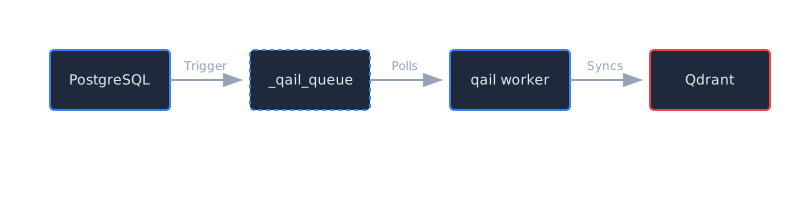
Setup
1. Initialize Hybrid Project
qail init
# Select "3. Hybrid (PostgreSQL + Qdrant)" when prompted
This creates phased delta files defining the _qail_queue table.
2. Configure Sync Rules
Define which tables should sync to Qdrant in qail.toml:
[[sync]]
source_table = "products"           # Table to watch
trigger_column = "description"      # Only sync if this column changes (optional optimization)
target_collection = "products_search" # Qdrant collection name
embedding_model = "candle:bert-base"  # (Coming soon)
3. Generate Triggers
Run the command to generate PostgreSQL triggers based on your rules:
qail sync generate
# Creates phased delta files for sync triggers
This generates triggers that:
- INSERT: Adds
UPSERTevent to queue. - UPDATE: Adds
UPSERTevent (only iftrigger_columnchanged). - DELETE: Adds
DELETEevent to queue.
4. Apply Migrations
Apply the migration files to your database:
qail migrate apply
5. Start Worker
Start the background worker to process the queue:
qail worker
Resilience
The qail worker is designed for production reliability:
- At-Least-Once Delivery: Events are only removed from the queue after successful sync to Qdrant.
- Circuit Breaker: If Qdrant goes down, the worker pauses and retries with exponential backoff (up to 30s).
- Per-Item Error Handling: A single reduced item won’t crash the worker; it will be marked with an error and retried later.
- Batch Processing: Updates are sent to Qdrant in batches for high throughput.
The _qail_queue Table
| Column | Type | Description |
|---|---|---|
id | SERIAL | Sequence ID for ordering |
ref_table | TEXT | Source table name |
ref_id | TEXT | Primary key of the source row |
operation | TEXT | UPSERT or DELETE |
payload | JSONB | Full row data (snapshot) |
status | TEXT | pending, processing, failed |
retry_count | INT | Number of failed attempts |
error_message | TEXT | Last error message |
Type System
QAIL provides type conversion between Rust and PostgreSQL.
Supported Types
| Rust Type | PostgreSQL Type | Notes |
|---|---|---|
String | TEXT, VARCHAR | UTF-8 |
i32 | INT4 | 32-bit integer |
i64 | INT8, BIGINT | 64-bit integer |
f64 | FLOAT8 | Double precision |
bool | BOOLEAN | |
Uuid | UUID | 128-bit |
Timestamp | TIMESTAMP | Microsecond precision |
Date | DATE | |
Time | TIME | |
Json | JSON, JSONB | |
Decimal | NUMERIC | Arbitrary precision |
Compile-Time Type Safety
QAIL uses the ColumnType enum for compile-time validation in schema definitions:
#![allow(unused)]
fn main() {
use qail_core::migrate::{Column, ColumnType};

// ✅ Compile-time enforced - no typos possible
Column::new("id", ColumnType::Uuid).primary_key()
Column::new("name", ColumnType::Text).not_null()
Column::new("email", ColumnType::Varchar(Some(255))).unique()

// Available types:
// Uuid, Text, Varchar, Int, BigInt, Serial, BigSerial,
// Bool, Float, Decimal, Jsonb, Timestamp, Timestamptz, Date, Time, Bytea
}
Validation at compile time:
primary_key()validates the type can be a PK (UUID, INT, SERIAL)unique()validates the type supports indexing (not JSONB, BYTEA)
Usage
Reading Values
#![allow(unused)]
fn main() {
use qail_pg::types::{Timestamp, Uuid, Json};
for row in rows {
let id: i32 = row.get("id")?;
let uuid: Uuid = row.get("uuid")?;
let created: Timestamp = row.get("created_at")?;
let data: Json = row.get("metadata")?;
}
}Temporal Types
#![allow(unused)]
fn main() {
use qail_pg::types::{Timestamp, Date, Time};
// Timestamp with microsecond precision
let ts = Timestamp::from_micros(1703520000000000);
// Date only
let date = Date::from_ymd(2024, 1, 15);
// Time only
let time = Time::from_hms(14, 30, 0);
}JSON
#![allow(unused)]
fn main() {
use qail_pg::types::Json;
let json = Json("{"key": "value"}".to_string());
}Custom Types
Implement FromPg and ToPg for custom types:
#![allow(unused)]
fn main() {
use qail_pg::types::{FromPg, ToPg, TypeError};
impl FromPg for MyType {
fn from_pg(bytes: &[u8], oid: u32, format: i16) -> Result<Self, TypeError> {
// Decode from wire format
}
}
impl ToPg for MyType {
fn to_pg(&self) -> (Vec<u8>, u32, i16) {
// Encode to wire format
(bytes, oid, format)
}
}
}Compile-Time Type Safety
New in v0.14.20 — Full Diesel-like type checking for QAIL queries
QAIL now supports compile-time type validation through generated schema files, similar to Diesel but with AST-native architecture.
Quick Start
1. Generate Schema
qail types schema.qail -o src/schema.rs
2. Use Type-Safe Builders
#![allow(unused)]
fn main() {
use crate::schema::users;
let query = Qail::get(users::TABLE)
.typed_column(users::id())
.typed_column(users::email())
.typed_eq(users::active(), true) // Compile-time: active must be bool
.typed_gt(users::age(), 18); // Compile-time: age must be numeric
}Schema Generation
Input: schema.qail
table users {
id uuid primary_key
email text not_null unique
name text
active boolean default true
age integer
created_at timestamptz default now()
}
Output: schema.rs
#![allow(unused)]
fn main() {
pub mod users {
use qail_core::typed::{TypedColumn, Table};
pub const TABLE: &str = "users";
pub fn id() -> TypedColumn<uuid::Uuid> {
TypedColumn::new("id")
}
pub fn email() -> TypedColumn<String> {
TypedColumn::new("email")
}
pub fn active() -> TypedColumn<bool> {
TypedColumn::new("active")
}
pub fn age() -> TypedColumn<i32> {
TypedColumn::new("age")
}
}
}Type-Safe Methods
| Method | Description | Example |
|---|---|---|
typed_eq(col, val) | Type-safe equality | typed_eq(users::active(), true) |
typed_ne(col, val) | Type-safe not-equal | typed_ne(users::status(), "banned") |
typed_gt(col, val) | Type-safe greater-than | typed_gt(users::age(), 18) |
typed_lt(col, val) | Type-safe less-than | typed_lt(users::balance(), 0.0) |
typed_gte(col, val) | Greater-than or equal | typed_gte(users::score(), 100) |
typed_lte(col, val) | Less-than or equal | typed_lte(users::priority(), 5) |
typed_column(col) | Add typed column | typed_column(users::email()) |
SQL to Rust Type Mapping
| SQL Type | Rust Type |
|---|---|
uuid | uuid::Uuid |
text, varchar | String |
integer, int4 | i32 |
bigint, int8 | i64 |
smallint, int2 | i16 |
boolean, bool | bool |
real, float4 | f32 |
double precision, float8 | f64 |
numeric, decimal | f64 |
timestamptz, timestamp | chrono::DateTime<Utc> |
date | chrono::NaiveDate |
jsonb, json | serde_json::Value |
bytea | Vec<u8> |
Reserved Keywords
Rust reserved keywords are automatically escaped:
| Column Name | Generated Function |
|---|---|
type | fn r#type() |
fn | fn r#fn() |
struct | fn r#struct() |
Compile-Time Errors
Type mismatches are caught at compile time:
#![allow(unused)]
fn main() {
// ✅ Compiles - active is bool
query.typed_eq(users::active(), true);
// ❌ Compile error - age is i32, not string
query.typed_eq(users::age(), "eighteen");
// error[E0277]: the trait bound `&str: ColumnValue<i32>` is not satisfied
}Integration with Existing Code
Type-safe methods can be mixed with dynamic methods:
#![allow(unused)]
fn main() {
let query = Qail::get(users::TABLE)
.typed_eq(users::active(), true) // Type-safe
.filter("created_at", Operator::Gte, "2024-01-01") // Dynamic
.typed_column(users::email());
}Row-Level Security (RLS)
QAIL carries tenant/user scope through the AST and driver pipeline, then
qail-pg sets transaction-local PostgreSQL GUCs before executing tenant
queries. PostgreSQL RLS policies remain the database enforcement boundary.
This gives application code a tenant-first API while keeping row isolation in the database:
#![allow(unused)]
fn main() {
use qail_core::prelude::*;
let ctx = RlsContext::tenant(tenant_id).with_user(user_id);
// Application startup: declare the complete AST-scoping registry once.
qail_core::rls::init_scope_registries_from_tables(
&[("bookings", "tenant_id")],
&[],
)?;
let query = Qail::get("bookings")
.columns(["id", "status", "total"])
.eq("status", "confirmed")
.with_rls(&ctx)?;
let rows = driver.fetch_all(&query).await?;
}The Problem
Multi-tenant apps fail when row ownership is treated as a convention:
#![allow(unused)]
fn main() {
// Easy to remember in one handler
let sql = "SELECT * FROM bookings WHERE tenant_id = $1";
// Easy to forget in another handler
let sql = "SELECT * FROM invoices";
}QAIL does not replace PostgreSQL RLS. It makes the tenant context explicit in the query/connection lifecycle so app code does not hand-roll scope setup on every call.
Declare The Isolation Mode At Startup
with_rls() refuses to run until the process explicitly chooses its isolation
mode. This prevents a missing registry initialization from turning every call
into an unscoped query.
For a process that owns a parsed schema.qail, initialize both scope
registries from that schema:
#![allow(unused)]
fn main() {
let source = std::fs::read_to_string("schema.qail")?;
let schema = qail_core::migrate::parse_qail(&source)?;
let counts = qail_core::rls::init_scope_registries(&schema)?;
}Embedded applications without a schema file can declare tables directly:
#![allow(unused)]
fn main() {
qail_core::rls::init_scope_registries_from_tables(
&[("orders", "tenant_id")],
&[("listings", "seller_id")],
)?;
}Two explicit no-injection modes are available:
declare_policy_only_isolation(reason)for applications that deliberately rely on PostgreSQL policies alone.declare_no_scoped_tables(reason)for a normal API whose schema genuinely contains no tenant- or owner-scoped tables.
The first declaration seals the process mode. Conflicting declarations fail, and unavailable registry state is an error rather than an empty registry.
Tenant And Owner Table Declarations
Tenant scope is inferred only from a literal tenant_id column. User/owner
scope is always explicit:
table orders {
id UUID primary_key
tenant_id UUID not_null
enable_rls
}
table listings {
id UUID primary_key
seller_id UUID not_null
owner seller_id
enable_rls
}
For orders, with_rls() injects tenant_id = ctx.tenant_id. For listings,
it injects seller_id = ctx.user_id. A table may carry both declarations; both
predicates then apply. Missing required context returns RlsScopeMissing
instead of executing an unscoped query. Owner columns are never inferred from
names such as user_id or seller_id.
Context Constructors
| Constructor | Scope | Use case |
|---|---|---|
RlsContext::tenant(id) | One tenant | Normal SaaS tenant scope |
RlsContext::tenant(id).with_user(user_id) | Tenant plus end user | Tenant dashboards with user-owned rows |
RlsContext::user(id) | User only | Auth flows or user-scoped policies before tenant is known |
RlsContext::global() | Shared/platform rows | tenant_id IS NULL style reference data |
RlsContext::empty() | No tenant scope | Startup introspection, migrations, health checks |
RlsContext::super_admin(token) | Full RLS bypass | Internal-only cross-tenant operations |
SuperAdminToken cannot be fabricated with public fields. It must be created
through a named constructor such as for_system_process, for_webhook, or
for_auth, which makes bypass intent visible at the call site.
RlsContext::empty() or user(...) cannot scope a registered
tenant table. Likewise, a context without a user cannot scope an owner table.
Those mismatches are build errors, not no-ops.
PostgreSQL Session Context
qail-pg opens a transaction and sets transaction-local context before the
query runs:
BEGIN;
SET LOCAL statement_timeout = ...;
SET LOCAL app.is_global = 'false';
SELECT
set_config('app.current_user_id', '<user>', true),
set_config('app.current_tenant_id', '<tenant>', true),
set_config('app.is_super_admin', 'false', true);
On release, the connection commits the transaction. Transaction-local GUCs and
SET LOCAL values reset on COMMIT, while prepared statement caches can remain
hot for reuse.
Absent UUID-shaped values are written as the nil UUID rather than an empty
string, so policies that cast current_setting(...) to uuid remain valid for
tenant-only, user-only, and global contexts.
PostgreSQL Policy Example
ALTER TABLE orders ENABLE ROW LEVEL SECURITY;
ALTER TABLE orders FORCE ROW LEVEL SECURITY;
CREATE POLICY orders_tenant_isolation ON orders
FOR ALL
USING (
tenant_id = current_setting('app.current_tenant_id', true)::uuid
OR current_setting('app.is_super_admin', true) = 'true'
)
WITH CHECK (
tenant_id = current_setting('app.current_tenant_id', true)::uuid
OR current_setting('app.is_super_admin', true) = 'true'
);
Use a database role that is not a superuser and does not have BYPASSRLS.
Superusers bypass RLS regardless of client-side discipline.
Horizontal And Vertical Access
RLS is horizontal: it decides which rows are visible or writable.
Native access policy is vertical: it decides which tables, operations, roles, scopes, and columns are allowed before the query reaches PostgreSQL.
Use both:
[access]
enabled = true
path = "access-policy.toml"
See Access Policy for operation and column semantics.
Gateway Behavior
qail-gateway extracts tenant/user/role/scope from JWT claims. tenant_id is
the primary runtime contract. A legacy agent_id claim is only used as a
secondary scope when tenant_id is present; it does not create tenant scope by
itself.
Header-based dev auth can provide the same claims only when QAIL_DEV_MODE=true
and the gateway is bound safely for development.
Guarantees And Non-Guarantees
| Property | Boundary |
|---|---|
| Tenant/user context is set before tenant queries | QAIL driver/gateway |
| Row filtering and write checks | PostgreSQL RLS policies |
| Operation and column permissions | Native access policy |
| Cross-tenant internal jobs | Explicit super_admin contexts |
| Provider/app authorization outside PostgreSQL | Application code |
If the database policy is wrong, QAIL cannot infer the correct row rule. If the application uses a raw connection outside the RLS-aware path, it owns the risk.
Operational Checklist
- Use
RlsContext::tenant(...)as the default runtime scope. - Attach
with_user(...)when database policies need user ownership. - Declare
owner <column>for user-owned tables; never rely on a suggestive column name alone. - Initialize the scope registries—or explicitly declare a no-injection
mode—before any call to
with_rls(). - Keep
agent_idas a secondary legacy scope, not the primary tenant identity. - Use transaction-local GUCs through
qail-pgpool/driver APIs. - Enable and force PostgreSQL RLS on tenant-owned tables.
- Run app roles as
NOBYPASSRLSnon-superusers. - Use native access policy for vertical permissions.
- Keep
super_admintoken creation limited to named internal paths.
Access Policy
QAIL has two different access-control layers:
- Row-Level Security (RLS) handles horizontal isolation: which rows a tenant, user, or platform context can see.
- Native access policy handles vertical isolation: which tables, operations, columns, roles, and scopes a subject can use before the AST reaches the database.
Use both for production SaaS APIs. RLS protects row ownership in PostgreSQL; the access policy protects the API and AST surface from reading or writing fields the subject should not be able to touch.
Where It Runs
Native access policy lives in qail_core::access. It checks a Qail command
directly, so it works before PostgreSQL execution:
#![allow(unused)]
fn main() {
use qail_core::access::{
AccessContext, AccessOperation, AccessPolicy, ColumnRule, TableAccessPolicy,
};
use qail_core::Qail;
let policy = AccessPolicy::new().with_table(
"orders",
TableAccessPolicy::new()
.allow_operations([AccessOperation::Read, AccessOperation::Update])
.read_columns(ColumnRule::only(["id", "status", "total"]))
.write_columns(ColumnRule::only(["status"]))
.require_any_role(["operator"])
.require_scopes(["orders:read"]),
);
let ctx = AccessContext::subject("user-1")
.with_tenant("tenant-1")
.with_role("operator")
.with_scope("orders:read");
let cmd = Qail::get("orders").columns(["id", "status"]);
policy.check_command(&ctx, &cmd)?;
}qail-gateway loads this policy when [access] is configured and applies it
to REST, QAIL text/binary, batch, transaction, RPC, and live-query paths before
execution.
Configuration
Enable gateway integration through qail.toml:
[access]
enabled = true
path = "access-policy.toml"
Policy files may be TOML or JSON. YAML is not supported for the native access policy.
Example access-policy.toml:
default_decision = "deny"
[tables.orders]
operations = ["read", "update"]
denied_operations = ["delete"]
read_columns = { only = ["id", "status", "total", "created_at"] }
write_columns = { only = ["status"] }
returning_columns = { only = ["id", "status"] }
require_any_role = ["operator", "administrator"]
require_scopes = ["orders:read"]
[tables.order_audit]
operations = ["read"]
read_columns = { except = ["internal_note"] }
require_any_role = ["administrator"]
require_scopes = ["audit:read"]
Use default_decision = "deny" for production. AccessPolicy::new() is
deny-by-default. AccessPolicy::allow_by_default() exists for trusted internal
tools, not public API exposure.
Operation Semantics
QAIL maps commands to the operations that must be allowed:
| AST action | Required operation |
|---|---|
GET, COUNT, EXPORT, WITH, SEARCH, SCROLL | read |
ADD | create |
SET, PUT, OVER | update |
UPSERT | create and maybe update, depending on conflict action |
DEL | delete |
MERGE | The operations used by each MERGE clause |
For MERGE, QAIL checks the target action clauses. A WHEN MATCHED UPDATE
requires update; WHEN NOT MATCHED INSERT requires create; DELETE
requires delete. The source table or source query also needs read policy.
Column Semantics
Column rules can be:
| Rule | Meaning |
|---|---|
any | Any column is allowed |
deny_all | No column is allowed |
{ only = [...] } | Only listed columns are allowed |
{ except = [...] } | Any column except listed columns is allowed |
Restrictive read rules reject wildcard projections. If a user can only read
id and status, then Qail::get("orders") is rejected because it means an
implicit wildcard. Use explicit columns:
#![allow(unused)]
fn main() {
Qail::get("orders").columns(["id", "status"])
}Read policy also covers filter columns, RETURNING, DISTINCT ON, grouping
sets, window partition/order expressions, relevant payload right-hand column
references, and recursively checked subqueries/CTEs.
Write policy covers explicit insert, update, upsert, and MERGE target columns. When a restrictive write rule is active, positional or ambiguous payloads fail closed because QAIL cannot prove which target column is being written.
Expressions And Fail-Closed Behavior
The checker allows expressions it can map back to a governed column. Examples:
columntable.column- JSON access that starts from a concrete column
- aggregate expressions with a concrete column argument
- aliases that preserve a concrete source column name
It rejects shapes that cannot be enforced precisely under a restrictive policy:
- wildcard projections
- unsupported projection expressions
- raw function payload values under restrictive read policy
- restrictive policy on auxiliary tables in
UPDATE FROMorDELETE USING - restrictive policy on a MERGE table source unless the source is represented as an explicit source query with projected columns
This behavior is intentional. If QAIL cannot prove that the AST respects the policy, the command is denied instead of guessed.
Relationship To Gateway Policy
qail-gateway still has a gateway policy engine for legacy per-table route
rules and filter injection. The native access policy is the current vertical
permission model because it lives in qail-core and checks the AST itself.
For new deployments:
- Use PostgreSQL RLS for row ownership.
- Use native
[access]policy for operation and column permissions. - Use gateway allow-listing, rate limits, EXPLAIN guardrails, and RPC controls as defense-in-depth around exposed routes.
Production Checklist
- Keep
default_decision = "deny". - Avoid wildcard projections for restricted roles.
- Split public and sensitive columns into explicit read/write rules.
- Require roles and scopes for privileged tables.
- Give source tables a read policy when using MERGE, subqueries, joins, or mutation source clauses.
- Use PostgreSQL RLS with a non-superuser role that has
NOBYPASSRLS. - Treat
super_admincontexts as internal-only and log their call sites.
Workflows
QAIL Flow Engine is a storage-agnostic workflow state machine for business flows that pause, resume, branch, notify, charge, and run QAIL AST queries.
QAIL Flow Ledger is the PostgreSQL-backed executor wrapper that stores the runtime guarantees needed for production: workflow state, leases, operation idempotency, side-effect replay, and timeout due-row discovery.
When To Use It
Use workflows for app-level processes where a single HTTP request is too small to model the real business state:
- WhatsApp booking recovery after an operator declines
- vendor notification and accept/decline loops
- payment charge creation followed by confirmation events
- timeout fallback paths when a user, vendor, or provider never responds
- multi-step inventory or booking reconciliation
Do not use workflows as a replacement for database transactions. Use normal transactions for one atomic database change. Use workflows when the process spans external systems and time.
Definition Model
A workflow definition is a named state machine. Each transition owns a list of steps:
#![allow(unused)]
fn main() {
use std::time::Duration;
use qail_core::Qail;
use qail_workflow::{ChannelKind, WorkflowDefinition, WorkflowStep};
let definition = WorkflowDefinition::new("booking_recovery")
.version("2026-06")
.initial_state("operator_declined")
.transition("operator_declined", "waiting_for_vendor", vec![
WorkflowStep::query(
&Qail::get("vendor_slots")
.columns(["id", "phone", "price"])
.eq("status", "available")
.limit(10),
Some("alternatives"),
),
WorkflowStep::for_each("alternatives", vec![
WorkflowStep::notify(
ChannelKind::WhatsApp,
"booking_opportunity",
"item.phone",
),
]),
WorkflowStep::wait_or(
"vendor.accepted",
Duration::from_secs(900),
vec![WorkflowStep::transition("timed_out")],
),
]);
}WorkflowStep::query persists QAIL wire text produced by
qail_core::wire::encode_cmd_text; it is not a raw SQL payload.
Runtime Operations
The public runtime entry points are:
| Operation | Use |
|---|---|
run_workflow | Execute from the current state until completion or wait |
resume_workflow_with_event | Resume a paused workflow with a named external event |
timeout_workflow | Execute the on_timeout fallback for the current wait |
timeout_due_workflows | Drain due workflow ids from the executor and timeout each one |
Use WorkflowRunOptions in production:
#![allow(unused)]
fn main() {
use std::time::Duration;
use qail_workflow::WorkflowRunOptions;
let options = WorkflowRunOptions::default()
.with_lease("worker-a", Duration::from_secs(30))
.with_idempotency_key("webhook:vendor.accepted:event-123");
}A lease prevents concurrent workers from executing the same workflow id at the same time. An idempotency key prevents the same external event, scheduler tick, or retry from running the workflow operation twice.
Executor Contract
qail-workflow is generic. Your application implements WorkflowExecutor for
business-side effects:
- execute a QAIL query payload
- send a notification
- create a payment charge
- save/load workflow state
- optionally acquire/release leases
- optionally record operation idempotency
- optionally record side-effect results
- optionally find due timeout rows
The default trait methods are permissive so tests and in-memory experiments are easy. Production executors should implement the runtime hooks. Otherwise, the engine can pause/resume, but it cannot prove distributed lease ownership, idempotent resume, or durable side-effect replay.
Flow Ledger For PostgreSQL
qail-workflow-postgres wraps an app executor:
#![allow(unused)]
fn main() {
use qail_workflow_postgres::{PgWorkflowExecutor, PgWorkflowStore};
let store = PgWorkflowStore::connect_url(database_url).await?;
store.install_schema().await?;
let executor = PgWorkflowExecutor::new(app_executor, store);
}For long-running services, reuse the service pool:
#![allow(unused)]
fn main() {
let pool = qail_pg::PgPool::connect(qail_pg::PoolConfig::from_url(database_url)?).await?;
let store = PgWorkflowStore::from_pool(pool);
}The default tables are:
qail_workflow_statesqail_workflow_leasesqail_workflow_operationsqail_workflow_side_effects
All store operations are built as QAIL AST commands and executed through
qail-pg.
Exactly-Once Semantics
The engine provides replay control, not magic exactly-once delivery.
| Risk | QAIL layer | Still owned by app/provider |
|---|---|---|
| Two workers resume same workflow id | Workflow lease | Lease TTL sizing and worker discipline |
| Duplicate webhook event | Operation idempotency key | Stable event id selection |
| Process crashes after query/charge/notify | Side-effect ledger | Provider idempotency key for external effects |
| Scheduler fires timeout twice | Timeout due-row claim + idempotency key | Stable scheduler batch ids |
| Completed side effect is reached again | Stored side-effect result replay | Result schema compatibility |
For payment and notification providers, pass the workflow side-effect operation id as the provider idempotency key whenever duplicates would be unsafe.
For checkout flows, set an explicit order origin in workflow context and pass it
through WorkflowStep::charge_with_origin. Use whatsapp for WhatsApp-created
orders, mcp for ChatGPT/MCP-created orders, web for web checkout,
ios_app for the native iOS app, and android_app for the native Android app
so provider metadata, order records, and analytics cannot mix the channels.
Charge output stored in context is a redacted payment display payload: show
QRIS/virtual-account details from that payload, and use only the redirect/payment
link for card flows.
Side-Effect Ledger
The engine wraps query, notify, and charge steps with stable side-effect ids. The ledger returns one of two decisions:
Execute: run the side effect now.AlreadyCompleted: skip execution and replay the stored result when needed.
Query and charge steps store their result because later workflow steps may need that value in context. Notification steps normally store no result; once they are completed, a replay skips delivery.
Failed side effects can be retried. Started side effects remain in progress
until the in-progress TTL expires; this lets another worker recover from a
crash after begin_* but before fail_* or complete_*.
Timeout Model
WorkflowStep::wait_or stores the expected event and a deadline in the cursor.
The engine does not spawn a background scheduler. Production apps should run a
worker that calls timeout_due_workflows with a stable idempotency key for the
drain attempt.
The Postgres Flow Ledger discovers due rows with row locking and a claim TTL so multiple timeout workers can run without picking the same workflow row at the same time.
Definition Versioning
Workflow contexts carry definition name and version. Resume and timeout paths validate cursor state against the supplied definition so an old paused cursor does not blindly continue through a different branch layout.
For production upgrades:
- Version workflow definitions.
- Keep old definitions available until paused runs drain.
- Avoid changing step order or branch paths for in-flight versions.
- Use explicit migration logic when an in-flight context shape changes.
v2 Side-Effect Id Rollout
Current side-effect operation ids include workflow state generation. This fixes replay identity for workflows that revisit the same state/step path after a state transition.
Deploy this over an empty or drained side-effect ledger. If a deployment has already-running v1 side-effect rows, either drain them before upgrading or explicitly accept replay risk for those in-flight workflows.
Production Checklist
- Wrap the app executor with
PgWorkflowExecutorfor Postgres deployments. - Install Flow Ledger tables before enabling workers.
- Use
WorkflowRunOptions::with_leasefor run/resume/timeout execution. - Use stable idempotency keys for webhook events and scheduler batches.
- Pass workflow side-effect ids to payment/notification providers.
- Set lease TTL and in-progress TTL longer than normal operation runtime.
- Keep old workflow definitions available while paused runs exist.
- Test crash/retry cases around notify, charge, query, resume, and timeout.
Centralized Configuration
Qail uses a single qail.toml file as the source of truth for all components. Configuration follows a layered priority:
Environment Variables > qail.toml > Hardcoded Defaults
Quick Start
Generate a config with qail init, or create qail.toml manually:
[project]
name = "my-app"
mode = "postgres"
[postgres]
url = "postgres://${DB_USER}:${DB_PASSWORD}@${DB_HOST:-localhost}:5432/mydb"
max_connections = 20
min_connections = 2
idle_timeout_secs = 600
acquire_timeout_secs = 30
connect_timeout_secs = 10
test_on_acquire = false
io_uring = false # opt in only; plain TCP on Linux builds with qail-pg/native-io-uring
[postgres.rls]
default_role = "app_user"
super_admin_role = "super_admin"
[qdrant]
url = "http://localhost:6333"
grpc = "localhost:6334"
max_connections = 10
[gateway]
bind = "0.0.0.0:8080"
cors = true
policy = "policies.yaml"
max_result_rows = 10000
statement_timeout_ms = 30000
explain_max_cost = 100000.0
explain_max_rows = 1000000
max_expand_depth = 3
tenant_max_concurrent = 10
# Per-role guard overrides — override global defaults for specific roles.
# Any field not specified here falls back to the global [gateway] default.
[gateway.role_overrides.reporting]
max_result_rows = 100000
statement_timeout_ms = 120000
explain_max_cost = 500000.0
[gateway.role_overrides.admin]
max_expand_depth = 5
[gateway.cache]
enabled = true
max_entries = 1000
ttl_secs = 60
[access]
enabled = true
path = "access-policy.toml"
[[sync]]
source_table = "products"
trigger_column = "description"
target_collection = "products_search"
embedding_model = "candle:bert-base"
Environment Variable Expansion
Use ${VAR} syntax inside TOML values to reference environment variables:
| Syntax | Behavior |
|---|---|
${VAR} | Required — errors if VAR is not set |
${VAR:-default} | Optional — uses default if VAR is not set |
$$ | Literal $ character |
Example:
[postgres]
url = "postgres://${DB_USER}:${DB_PASSWORD}@${DB_HOST:-localhost}:5432/mydb"
Set DB_USER and DB_PASSWORD in your .env or shell. DB_HOST falls back to localhost if unset.
Environment Variable Overrides
These env vars always override their TOML counterparts, regardless of ${VAR} expansion:
| Env Var | Overrides |
|---|---|
DATABASE_URL | [postgres].url |
QDRANT_URL | [qdrant].url |
QAIL_BIND | [gateway].bind |
This lets you keep one qail.toml across dev/staging/prod and switch databases purely via env vars.
Usage in Rust
PostgreSQL Pool (one-liner)
#![allow(unused)]
fn main() {
use qail_pg::driver::pool::PgPool;
let pool = PgPool::from_config().await?;
}Manual Config Loading
#![allow(unused)]
fn main() {
use qail_core::config::QailConfig;
use qail_pg::driver::pool::PoolConfig;
let qail = QailConfig::load()?; // reads ./qail.toml
let pg_config = PoolConfig::from_qail_config(&qail)?; // parse postgres section
let pool = PgPool::connect(pg_config).await?;
}Qdrant
#![allow(unused)]
fn main() {
use qail_qdrant::pool::PoolConfig as QdrantPoolConfig;
let qail = QailConfig::load()?;
if let Some(config) = QdrantPoolConfig::from_qail_config(&qail) {
let pool = QdrantPool::new(config).await?;
}
}Gateway
#![allow(unused)]
fn main() {
use qail_gateway::config::GatewayConfig;
let qail = QailConfig::load()?;
let gw = GatewayConfig::from_qail_config(&qail);
}Section Reference
| Section | Required | Description |
|---|---|---|
[project] | Yes | Project name, mode (postgres/qdrant/hybrid), schema path |
[postgres] | Yes | Database URL and pool tuning |
[postgres.rls] | No | RLS role names |
[qdrant] | No | Qdrant REST + gRPC endpoints |
[gateway] | No | HTTP server bind, CORS, cache |
[access] | No | Native vertical access policy file |
[[sync]] | No | Vector sync rules (hybrid mode) |
Native Access Policy
RLS handles row ownership; [access] handles operation and column access before
the gateway sends a QAIL AST to Postgres. It is opt-in:
[access]
enabled = true
path = "access-policy.toml"
Example access-policy.toml:
default_decision = "deny"
[tables.orders]
operations = ["read", "update"]
read_columns = { only = ["id", "status", "total"] }
write_columns = { only = ["status"] }
require_any_role = ["operator", "administrator"]
require_scopes = ["orders:read"]
Policy files may be TOML or JSON. When enabled = true, path is required.
See Access Policy for the full operation, column, role,
scope, and fail-closed semantics.
Generated Files
qail init creates:
qail.toml— project config with commented-out optional sections.env.example— documents all supported env var overrides
CLI Commands
The qail command-line tool — v2.0.0.
Installation
cargo install qail
Commands
qail init
Initialize a new QAIL project. Auto-detects running PostgreSQL instances on the host, Docker, and Podman.
# Interactive mode — scans for running databases
qail init
# 🪝 QAIL Project Initialization
# Scanning for PostgreSQL instances...
# ✓ Found 2 instance(s):
# 1. 🖥 host localhost:5432 (host)
# 2. 🐳 docker localhost:5433 (docker) — my-pg
# 3. Enter URL manually
# Select [1-3]:
# Non-interactive mode (CI/scripting)
qail init --name myapp --mode postgres --url postgres://localhost/mydb
qail init --name myapp --mode hybrid --url postgres://localhost/mydb --deployment docker
Options:
--name <NAME>: Project name--mode <MODE>: Database mode (postgres,qdrant,hybrid)--url <URL>: Database URL (skips interactive prompt)--deployment <TYPE>: Deployment type (host,docker,podman)
Generates qail.toml and necessary migration files.
qail exec
Execute QAIL statements against a database:
# Inline queries
qail exec "get users'id'email[active = true]" --url postgres://...
qail exec "add users fields name, email values 'Alice', 'a@test.com'" --url postgres://... --tx
qail exec "set users[id = 1] fields name = 'Bob'" --url postgres://...
# Count rows
qail exec "cnt orders[status = 'paid']" --url postgres://...
# → SELECT COUNT(*) FROM orders WHERE status = 'paid'
# JSON output (pipe-friendly)
qail exec "get users" --url postgres://... --json
qail exec "get users" --url postgres://... --json | jq '.[].email'
# From file
qail exec -f seed.qail --url postgres://...
# Dry-run (preview generated SQL)
qail exec "get users'*'" --dry-run
# 📋 Parsed 1 QAIL statement(s)
# 🔍 DRY-RUN MODE — Generated SQL:
# SELECT * FROM users
# With SSH tunnel
qail exec "get users" --url postgres://remote/db --ssh user@bastion
Syntax:
add <table> fields <col1>, <col2> values <val1>, <val2>
set <table>[id = $1] fields name = 'new', updated_at = now
del <table>[id = $1]
get <table>'id'name[active = true]
cnt <table>[active = true]
Value Types:
| Type | Examples |
|---|---|
| Strings | 'hello', "world" |
| Numbers | 42, 3.14, -1 |
| Booleans | true, false |
| Null | null |
| Parameters | $1, $2, :name |
| Intervals | 24h, 7d, 30m |
| JSON | ["a", "b"], {"key": "val"} |
| Timestamp | now |
Options:
-f, --file <FILE>: Path to.qailfile with statements-u, --url <URL>: Database connection URL--json: Output SELECT results as JSON array--tx: Wrap all statements in a transaction--dry-run: Preview generated SQL without executing--ssh <USER@HOST>: SSH tunnel via bastion host
qail pull
Extract schema from a live database:
qail pull postgres://user:pass@localhost/db > schema.qail
qail diff
Compare two schemas or detect drift against a live database:
# Compare two schema files
qail diff old.qail new.qail
qail diff old.qail new.qail --format json
# Live drift detection (introspects running database)
qail diff _ schema.qail --live --url postgres://localhost/mydb
# Drift detection: [live DB] → schema.qail
# → Introspecting live database...
# 80 tables, 287 indexes introspected
# ✅ No drift detected — live DB matches schema file.
Options:
--format <FMT>: Output format (sql,json,pretty)--live: Use live database introspection as “old” schema--url <URL>: Database URL (required with--live)
qail check
Validate a schema file or preview migration safety:
# Validate schema
qail check schema.qail
# ✓ Schema is valid
# Tables: 80 | Columns: 1110 | Indexes: 287
# ✓ 82 primary key(s)
# Validate modular schema directory
qail check schema/
# Fallback mode: if schema.qail is missing, sibling schema/ is used
qail check schema.qail
# Check migration safety
qail check old.qail:new.qail
# ✓ Both schemas are valid
# Migration preview: 4 operation(s)
# ✓ 3 safe operation(s)
# ⚠️ 1 reversible operation(s)
Migrate Commands
qail migrate status
View migration history with rich tabular output:
qail migrate status postgres://...
# 📋 Migration Status — mydb
# ┌──────────┬────────────────────┬─────────────────────┬──────────────┐
# │ Version │ Name │ Applied At │ Checksum │
# ├──────────┼────────────────────┼─────────────────────┼──────────────┤
# │ 001 │ qail_queue │ 2026-02-01 10:00:00 │ a3b8d1... │
# │ 002 │ add_users │ 2026-02-05 14:32:00 │ f81d4f... │
# └──────────┴────────────────────┴─────────────────────┴──────────────┘
qail migrate apply
Apply file-based migrations from deltas/ with the expand/backfill/contract model:
# Add compatible schema first
qail migrate apply --phase expand
# Move existing data in resumable chunks
qail migrate apply --phase backfill --backfill-chunk-size 10000
# Remove old schema only after code references are gone
qail migrate apply --phase contract --codebase ./src
Phased migrations may be stored as:
deltas/
20260527090000_add_user_name/
expand.qail
backfill.qail
contract.qail
Use --phase all only when a release is safe to run through all phases in order. For rollback, use qail migrate rollback --to <version> or apply explicit down files with qail migrate apply --direction down.
qail migrate plan
Preview migration SQL without executing (dry-run):
qail migrate plan old.qail:new.qail
# 📋 Migration Plan (dry-run)
# ┌─ UP (2 operations) ─────────────────────────────────┐
# │ 1. ALTER TABLE users ADD COLUMN verified BOOLEAN
# │ 2. CREATE INDEX idx_users_email ON users (email)
# └─────────────────────────────────────────────────────┘
# Save to file
qail migrate plan old.qail:new.qail --output migration.sql
qail migrate analyze
Analyze codebase for breaking changes before migrating:
qail migrate analyze old.qail:new.qail --codebase ./src
# 🔍 Migration Impact Analyzer
# Scanning codebase... Found 395 query references
#
# ⚠️ BREAKING CHANGES DETECTED
# ┌─ DROP TABLE promotions (6 references) ─────────────┐
# │ ❌ src/repository/promotion.rs:89 → INSERT INTO...
# │ ❌ src/repository/promotion.rs:264 → SELECT...
# └────────────────────────────────────────────────────┘
qail migrate apply --phase all
Apply all pending file-based migration phases from deltas/:
qail migrate apply
# → Found 1 migrations to apply
# ✓ Connected to mydb
# → 20260527090000_add_user_name/expand.qail... ✓
# ✓ All migrations applied successfully!
qail migrate reset
Nuclear option — drop all objects, clear history, re-apply target schema:
qail migrate reset schema.qail postgres://...
# ⚠️ This will DROP all tables, clear migration history, and recreate from schema.
# Phase 1: DROP all tables...
# Phase 2: CLEAR migration history...
# Phase 3: CREATE from schema...
# ✓ Reset complete
qail migrate shadow
Test migrations against a shadow database:
qail migrate shadow v1.qail:v2.qail postgres://shadow-db/...
Other Commands
qail explain
Parse and explain a QAIL query:
qail "get users'id'email[active = true]"
# SELECT id, email FROM users WHERE active = true
qail repl
Interactive QAIL REPL — type queries, see SQL in real-time:
qail repl
# QAIL REPL
# Type QAIL queries, see SQL output.
# qail> get users[active = true]
# SELECT * FROM users WHERE active = true
qail types
Generate typed Rust schema from .qail file:
qail types schema.qail > src/generated/schema.rs
qail watch
Watch schema file for changes and auto-generate migrations:
qail watch schema.qail --url postgres://... --auto-apply
qail lint
Check schema for best practices:
qail lint schema.qail
# 🔍 Schema Linter
# ⚠ 144 warning(s)
# ℹ 266 info(s)
| Check | Level | Description |
|---|---|---|
| Missing primary key | 🔴 ERROR | Every table needs a PK |
| Missing created_at/updated_at | ⚠️ WARNING | Audit trail columns |
_id column without references() | ⚠️ WARNING | FK integrity |
| Uppercase table names | ⚠️ WARNING | Use snake_case |
qail sync generate
Generate trigger migrations from [[sync]] rules in qail.toml (Hybrid mode):
qail sync generate
# ✓ Created phased delta files for sync triggers
qail worker
Start the background worker to sync PostgreSQL → Qdrant (Hybrid mode):
qail worker --interval 1000 --batch 100
Global Options
| Flag | Description |
|---|---|
-f, --format | Output format (sql, ast, json) |
-d, --dialect | Target SQL dialect (postgres — the only SQL target since 2.0) |
-v, --verbose | Verbose output |
--version | Show version |
--help | Show help |
API Reference
Full API documentation is generated from source code.
Rust Crates
| Crate | Description | Docs |
|---|---|---|
qail-core | AST, Builder, Parser | docs.rs |
qail-pg | PostgreSQL driver | docs.rs |
qail-gateway | Auto-REST gateway | docs.rs |
qail | CLI and tooling | docs.rs |
SDKs
| SDK | Status | Distribution |
|---|---|---|
TypeScript (@qail/client) | Supported | npm |
Swift (sdk/swift) | Supported | Source package |
Kotlin (sdk/kotlin) | Supported | Source module |
| Node.js native binding | Deferred | Not published |
| WASM binding | Deferred | Not published |
Generate Local Docs
cargo doc --no-deps --open
Key Types
qail-core
Qail- Query command builderOperator- Comparison operatorsSortOrder- ASC/DESCExpr- Expression AST nodesQailBuildError- Structured builder error type
qail-pg
PgDriver- Database connectionPgPool- Connection poolPgRow- Result rowPgError- Error types
1.0 API Notes
- Use
Qail::get/add/set/deland typed builder methods for normal database work. - Declare the process isolation mode at startup with
init_scope_registries,init_scope_registries_from_tables,declare_policy_only_isolation, ordeclare_no_scoped_tables, then usewith_rls(&ctx)?. - The older
try_with_rls()alias is removed. - Use
join_on(...)?for schema-driven relation joins; the oldertry_join_on()alias is removed. - Use bytes-native PostgreSQL cancel-key APIs instead of legacy
i32wrappers. - Keep
QailBuildErrorstructured; broad string conversion is no longer part of the stable API. - Avoid raw SQL builder APIs on the public runtime path. Session settings should use session AST commands.
Source Code
View the source on GitHub:
Changelog
For the full project changelog, see the repository file:
Current Highlights (v2.0.0)
- JOIN array membership parity:
is_array_unnestexpands to the sameEXISTS/unnestSQL in the PostgreSQL wire encoder and the core transpiler; unsupported JOIN pattern operators fail closed. - Aggregate qualifier validation:
GROUP BYandDISTINCT ONqualifiers are checked against the active relation scope, including alias hiding and CTE visibility rules, before application code can ship invalid SQL. - Qualified RLS injection: tenant/owner predicates name their primary relation, avoiding PostgreSQL
42702ambiguity on joined queries; schema-qualified CROSS joins retain every registered relation’s predicate. - Fail-closed payload de-duplication: identical repeated assignments collapse, while conflicting tenant/owner stamps remain an encoder error instead of overriding the value injected by
with_rls(). - RLS scope hardening:
with_rls()fails closed on registered tables, scope registries are declared once at the application boundary (init_scope_registries/declare_policy_only_isolation), owner (owner <column>) scoping joins tenant scoping, andON CONFLICT DO UPDATEcarries the scope predicate viaOnConflict.where_conditions. - 1.x compatibility surfaces removed: the
qail-encoderC ABI, SQLite/DynamoDB/MongoDB transpilers, the agent identity plane (app.current_agent_id), the function-pointer GSS callback, the JWTuser_idalias,auth_mode=compat, deprecated SDK aliases, and theio_uringfeature alias. See the repository CHANGELOG[2.0.0-rc.1]section for per-item migration notes. - Release line: Rust workspace crates and install snippets are bumped to
2.0.0;qail-workflow,qail-workflow-postgresandqail-gatewayare in the crates.io publish set.
v1.4.0 Highlights
- Views can declare
security_invoker:view <name> security_invoker $$ … $$parses, renders, compiles toCREATE VIEW … WITH (security_invoker = true), and survivesqail pullby being read back frompg_class.reloptions. Without it, a view over an RLS-protected table evaluates that table’s policies as the view owner and silently bypasses them. Owner-rights stays the default, matching PostgreSQL. qail pullintrospects grants:relaclis parsed intoschema.grants, so a relation missing a grant to the application role is now visible inschema.qailinstead of failing at runtime as[42501] permission deniedwith nothing to diff. Recovered 229 grants on a live 217-table database that previously showed zero. Privileges with noschema.qailspelling are reported on stderr rather than dropped.rls::tenant::scoping_applies(): callers and audits can assert that tenant scoping actually applied — in 1.4,with_rlsfailed open on unregistered relations (2.0 fails closed).- Release line: Rust workspace crates and install snippets were bumped to
1.4.0.
v1.3.6 Highlights
- PostgreSQL dependency correctness:
cmov0.5.4fixes incorrect AArch64 constant-time selection results in the dependency path used by PostgreSQL SCRAM authentication. - Gateway dependency safety:
crossbeam-epoch0.9.20resolves RUSTSEC-2026-0204 in the metrics and cache dependency paths. - Extension build tooling: VSCE
3.9.2resolves theform-dataandmarkdown-itadvisories without changing the shipped extension runtime. - PostgreSQL io_uring opt-in security: Linux
io_uringplain-TCP transport no longer auto-enables on kernel support; enable it explicitly with[postgres].io_uring = true,?io_uring=true, driver/pool options, orQAIL_PG_IO_BACKEND=io_uring. - Tokio remains the safe default: building with the
qail-pg/io_uringfeature only makes the backend available; TLS, mTLS, and GSSENC paths continue to use Tokio transport. - Workflow payment hardening: charge side effects now default to stable workflow idempotency keys, support order-origin metadata, and store redacted payment display payloads for chat/notification use.
- Release line: Rust workspace crates and install snippets are bumped to
1.3.6.
v1.3.0 Highlights
- Detailed changelog: QAIL.rs v1.3.0: Native Vertical Policy and the Audit Pass Behind It
- Native vertical access policy:
qail_core::accessadds deny-by-default table policies, role/scope requirements, operation permissions, and read/write/returning column rules before AST execution. - Gateway policy integration:
[access]inqail.tomlloads TOML/JSON policies so gateway REST, QAIL text/binary/batch, transaction, RPC, nested, expanded, and live-query paths can enforce vertical table and column boundaries alongside PostgreSQL RLS. - PostgreSQL statement cache safety: hot prepared statements are promoted, evicted, reparsed, and retained only in states that match the real backend statement lifecycle.
- Migration verification: composite foreign-key options now survive parse/diff/apply and strict post-apply checks verify table constraints against the live database.
- Gateway hardening: precise numerics, oversized integers, Qdrant JSON integer drift, transaction subqueries, branch replay, and tenant guard exemptions are handled on explicit fail-closed paths.
- Workflow and encoder fixes: workflow guards, charge amounts, branch cursors, null bind params, zero-parameter binds, and Qdrant vector byte order were tightened.
- SDK path safety: TypeScript, Kotlin, and Swift SDK builders encode table and ID path segments before constructing REST routes.
- Real database validation: PostgreSQL lab coverage passed for strict migrations, MERGE, access-checked execution, seeded RLS, and gateway native access policy behavior.
v1.2.1 Highlights
- Schema parser compatibility: pulled PostgreSQL schemas now accept table-level
enable_rlsandforce_rlsdirectives. - PostgreSQL type parsing: multi-word types such as
DOUBLE PRECISIONandTIMESTAMP WITH TIME ZONEparse correctly from pulled schemas. - Comment parsing: schema comments containing quoted examples no longer break parsing.
v1.2.0 Highlights
- PostgreSQL protocol safety: COPY, LISTEN/NOTIFY, replication, pooled fetch, driver fetch, query, and pipeline paths now fail closed and desynchronize bad connections on malformed backend state.
- NUL and UTF-8 hardening: savepoints, SQL rendering, AST SQL buffers, gateway explain SQL, COPY text rows, backend wire strings, and PostgreSQL URL decoding now reject invalid input instead of silently mutating it.
- Real database validation: PostgreSQL 18 lab coverage passed for MERGE, set operations, recursive CTEs, cursor cleanup, COPY callback recovery, LISTEN/NOTIFY payloads, savepoint rejection, and NUL query rejection.
v1.1.1 Highlights
- Live migration introspection: schema pulls and shadow verification now account for generated columns, identity defaults, expression indexes, enum extensions, and composite foreign-key drift.
- Migration replay safety: post-apply checks compare constraints, defaults, generated expressions, indexes, and extension dependencies against the real database state.
- Branch overlay coverage: live PostgreSQL audit paths verify merge, set-operation, recursive-CTE behavior, and bad overlay replay failure modes.
v1.1.0 Highlights
- Workflow engine hardening: fixed nested loop context preservation, wait-event resume validation, timeout fallbacks, and transition checkpointing.
- Gateway security hardening: tightened tenant guards, RLS policy injection, write-side column policies, idempotency, transaction paths, branch overlays, and REST mutation/event semantics.
- Qdrant tenant safety: tenant-scoped vector upserts now namespace point IDs while preserving the caller-facing original ID.
- Branch overlay correctness: branch reads and merges now use deterministic chronological ordering with post-policy filtering and projection.
- Durable events: webhook delivery now has an outbox-backed path and stricter old/new payload handling.
- Runtime surface cleanup: the supported stable runtime is centered on PostgreSQL and Qdrant; legacy SQLite/DynamoDB/MongoDB transpiler symbols remain compatibility-only for 1.x consumers, and obsolete PostgreSQL examples were removed.
v1.0.0 Highlights
- Promoted QAIL to 1.0.0 Stable, declaring the API complete and production-grade.
- gRPC Connection State Machine: Implemented concurrent reconnection protection using a connection generation counter in the Qdrant engine.
- Webhook Scaling: Scaled webhook concurrency limit to 512 paired with safe timeouts.
- Connection Pool Locking: Replaced async-wait locks with standard library
unwrapsynchronization under heavy concurrent loads. - Workspace Crates: All workspace crates, internal path dependencies, and VSCode LSP extension bumped to
1.0.0. - API Cleanup Carried Into 1.0:
try_with_rls()andtry_join_on()compatibility aliases are gone; callwith_rls(&ctx)?andjoin_on(...)?on the fallible path. - Raw SQL Runtime Surface:
Qail::raw_sql(...),Qail::is_raw_sql(),Qail::raw_where(...), andQail::nextval(...)are not part of the stable public runtime path. - Cancel-Key API: legacy
i32cancel-key wrappers are gone; use bytes-native cancel-key APIs. - Error Conversion: broad
From<QailBuildError> for Stringcompatibility conversion was removed so callers keep structured build errors.